

The Secret of the Hidden Light
This lesson can be read on www.tebeka.com. Printing is for signed-in users only. © Rabbi Haim Tebeka.

On the first day of Creation, before the sun and the moon, Hashem made a light. With it, the Sages say, a person could see from one end of the world to the other. Then Hashem hid it. In my sheet on Parshas Vayeira I wrote about this hidden light, the Or HaGanuz, and many of you asked me to go further. So in this lesson I tell where the light went: into Shabbos, into the Torah, and into the days of Mashiach. I show where it shines in our davening, from the tallis in the morning to the flame of Havdalah; and I bring what the Baal Shem Tov, the Alter Rebbe and the Rebbe teach about a light so strong that it looks like darkness, and about our work of turning darkness into light. Then, as always, every word is taken apart. The new grammar (§G44 to §G46) is the hollow root, the letters that count, and a word that can be read two ways. How to make Havdalah in practice is a question for your rav.
The light of the first day
The Torah begins with light. “And Elokim said: Let there be light, and there was light. And Elokim saw the light, that it was good, and Elokim separated between the light and the darkness” (Bereishis 1:3-4). The sun and the moon were made only on the fourth day. So what was this light?
The Gemara in Chagigah (12a) answers in the words of Rabbi Elazar: with the light that the Holy One, blessed be He, created on the first day, a man could look from one end of the world to the other. When Hashem looked at the generation of the Flood and the generation of the Dispersion and saw that their deeds were corrupt, He rose and hid it from them. For whom did He hide it? For the righteous in the time to come, as it says “And Elokim saw the light, that it was good”, and “good” means only a tzaddik.
The Gemara also brings the view of the Sages, that these were the luminaries themselves, created on the first day and hung in the sky on the fourth. I follow, in this lesson, the teaching of Rabbi Elazar, which is the one that Rashi, the Midrash and Chassidus build on: a first light, greater than the sun, that was hidden away.
וַיַּרְא אֱלֹהִים אֶת הָאוֹר כִּי טוֹבאוֹר שֶׁבָּרָא הַקָּדוֹשׁ בָּרוּךְ הוּא בְּיוֹם רִאשׁוֹן, אָדָם צוֹפֶה בּוֹ מִסּוֹף הָעוֹלָם וְעַד סוֹפוֹ.כֵּיוָן שֶׁנִּסְתַּכֵּל הַקָּדוֹשׁ בָּרוּךְ הוּא בְּדוֹר הַמַּבּוּל וּבְדוֹר הַפְּלַגָּה וְרָאָה שֶׁמַּעֲשֵׂיהֶם מְקוּלְקָלִים — עָמַד וּגְנָזוֹ מֵהֶןוּלְמִי גְּנָזוֹ — לַצַּדִּיקִים לֶעָתִיד לָבֹאוְאֵין ״טוֹב״ אֶלָּא צַדִּיק
Talmud, Chagigah 12a · Gemara text via Sefaria; quoted · sefaria.org/Chagigah.12a
“He saw that the wicked were not worthy”
Rashi brings this teaching on the words “that it was good” (Bereishis 1:4): Hashem saw that the wicked were not worthy to use it, and He set it apart for the righteous in the time to come. That is why the verse says “and Elokim separated”: He separated the light itself, and put it aside.
The Midrash (Bereishis Rabbah 3:6) asks the question that every child asks: “And where is it?” And answers: “It was hidden away, and it is prepared for the righteous in the time to come.” The Midrash adds a verse of Yeshayahu (30:26): in that day the light of the moon will be like the light of the sun, and the light of the sun will be sevenfold, like the light of the seven days.
In my sheet on Parshas Vayeira I wrote about this light, and I want to stay with it here, because it is not only a story about the past. It is hidden, not lost. And our siddur, as we will see, speaks about it every single morning.
רָאָהוּ שֶׁאֵינוֹ כְדַאי לְהִשְׁתַּמֵשׁ בּוֹ רְשָׁעִים, וְהִבְדִּילוֹ לַצַּדִּיקִים לֶעָתִיד לָבֹאוְהֵיכָן הִיא, נִגְנְזָה, וְהִיא מְתֻקֶּנֶת לַצַּדִּיקִים לֶעָתִיד לָבוֹא
Bereishis Rabbah 3:6 · Hebrew text via Sefaria; quoted · sefaria.org/Bereishit_Rabbah.3.6
Yeshayahu 30:26 · Hebrew text via Sefaria; paraphrased · sefaria.org/Isaiah.30.26
Hidden, but first it shone for Shabbos
Another Midrash (Bereishis Rabbah 11:2) tells when the light was hidden. When the sun set at the end of the first Friday, the Holy One, blessed be He, wished to hide the light, “and He gave honor to Shabbos”. That, says the Midrash, is the meaning of “And Elokim blessed the seventh day”: He blessed it with light. So that light served for thirty-six hours: the twelve hours of Friday, the twelve hours of Friday night, and the twelve hours of Shabbos day.
When Shabbos ended and darkness began to come, Adam was afraid. The Midrash brings the verse of Tehillim (139:11): “Surely the darkness will cover me.” What did Hashem do? He prepared for him two flints; Adam struck them one against the other, fire came out, and he made a blessing over it. Which blessing? “Borei me’orei ho’eish”, Who creates the lights of the fire.
Other Sages hold that the light was hidden already on the fourth day, or even at the end of the first day; the Rebbe brings these views in his sichah, in a note. But the Midrash of the thirty-six hours tells us something precious: the light of the first day belongs, in a special way, to Shabbos. In the words of my Vayeira sheet: every Shabbos is a taste of that light.
בִּקֵּשׁ הַקָּדוֹשׁ בָּרוּךְ הוּא לִגְנֹז אֶת הָאוֹרָה, וְחָלַק כָּבוֹד לַשַּׁבָּתבֵּרְכוֹ בְּאוֹרָהל"ו שָׁעוֹת שִׁמְשָׁה אוֹתָהּ הָאוֹרָהזִמֵּן לוֹ שְׁנֵי רְעָפִים וְהֵקִישָׁן זֶה לָזֶה וְיָצָא מֵהֶן אוֹר וּבֵרַךְ עָלֶיהָמַה בֵּרַךְ עָלֶיהָ, בּוֹרֵא מְאוֹרֵי הָאֵשׁ
The Rebbe, Likkutei Sichos, vol. 10, p. 7ff. (Simchas Torah 5726), “Bereishis: A Mission of Light”, Chabad.org · Hebrew original quoted; English translation quoted and paraphrased · chabad.org/…/aid/4561342
Havdalah: the first fire, every week
This is why we bless over fire at the end of Shabbos. The Gemara (Pesachim 54a) says: “We bless over fire only at the going out of Shabbos, since that is the beginning of its creation.” And there too: Adam brought two stones, rubbed them together, and fire came out.
The Alter Rebbe writes in his Shulchan Aruch (298:1) that this blessing was ordained “to commemorate the creation of fire on Saturday night”. And he adds a second reason: fire was forbidden all Shabbos and is now permitted again, so “it is as if it was now created anew.”
The Midrash (Bereishis Rabbah 3:6) learns from the first verses of the Torah that one does not bless over the candle until one has benefited from its light: first “He saw the light”, then “He separated”. Kitzur Baal HaTurim adds a number: וַיַּבְדֵּל, “He separated”, has the value 52, as the number of Havdalos we make in a year, at the end of every Shabbos (§G45).
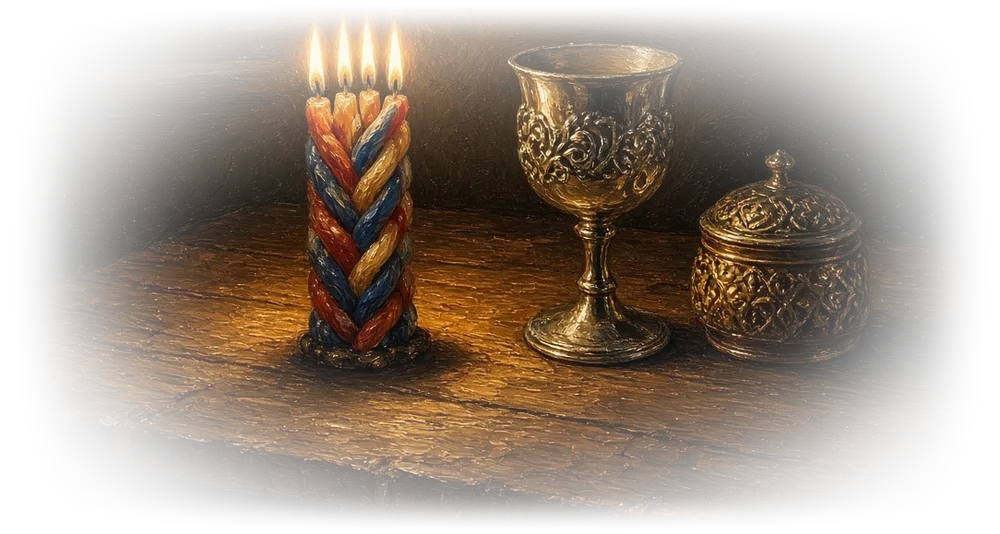
So at Havdalah we hold up the braided candle and say “Borei me’orei ho’eish”. Then, in the next blessing, we praise Hashem “Who separates between holy and weekday, between light and darkness”. Chabad.org’s Havdalah page writes that everyone looks at the flame and enjoys the light, and that it is customary to lift one’s fingertips so that the flame’s glow falls on them. How to make Havdalah in practice is for your rav.
אֵין מְבָרְכִין עַל הָאוּר אֶלָּא בְּמוֹצָאֵי שַׁבָּת, הוֹאִיל וּתְחִילַּת בְּרִיָּיתוֹ הוּאלְזֵכֶר שֶׁנִּבְרָא הָאוּר בְּמוֹצָאֵי שַׁבָּתהֲרֵי זֶה כְּאִלּוּ נִבְרָא עַתָּה מֵחָדָשׁמִנַּיִן שֶׁאֵין מְבָרְכִין עַל הַנֵּר עַד שֶׁיֵּאוֹתוּ לְאוֹרוֹכמנין ויבדל מבדילין בשנה במוצאי שבתותהַמַּבְדִּיל בֵּין קֹדֶשׁ לְחוֹל בֵּין אוֹר לְחֹשֶׁךְ
Shulchan Aruch HaRav, Orach Chaim 298:1 (Sichos in English) · Hebrew text quoted; English quoted and paraphrased · chabad.org/…/aid/3447090
Bereishis Rabbah 3:6 · Hebrew text via Sefaria; quoted · sefaria.org/Bereishit_Rabbah.3.6
Kitzur Baal HaTurim on Bereishis 1:4 · Hebrew text via Sefaria; quoted as printed, unvoweled · sefaria.org/Kitzur_Baal_HaTurim_on_Genesis.1.4
Chabad.org: Havdalah Blessings and Instructions · Hebrew text of the blessing; checked letter by letter Nov 3, 2026; instructions paraphrased · chabad.org/…/aid/253217
Where was it hidden? In the Torah
Hidden, yes, but where? The Rebbe writes in a sichah (Likkutei Sichos, vol. 10): “Where was the light stored away? Our Sages teach that G‑d stored it in the Torah. In this manner, even when hidden it continually impacts all of creation.” In a note the Rebbe gives the source of this teaching, the Zohar (the Midrash on Rus in the Zohar Chadash, and the Zohar itself), and he writes that the Degel Machaneh Ephraim brings it in the name of the Baal Shem Tov, and Kesser Shem Tov in the name of the Maggid of Mezritch, quoting the Baal Shem Tov.
I opened the Degel. Rabbi Moshe Chaim Ephraim of Sudilkov, the grandson of the Baal Shem Tov, writes: I heard from my grandfather, “where was that light hidden? And he said that Hashem hid it in the Torah, and therefore the tzaddikim in every generation use that light, that is, through the Torah.” Then he tells a story. The Baal Shem Tov once wrote to his brother-in-law, Rabbi Gershon of Kitov, who lived in the Holy Land, that he had seen him on a certain Shabbos outside the Land, and asked what he was doing there. Rabbi Gershon wrote back that on that Shabbos a wealthy man abroad had made a bris and had sent for him to be the mohel. How could the Baal Shem Tov see so far? “All of it was through that light that is hidden in the Torah.” And the Degel adds: the Baal Shem Tov explained that אֶת הָאוֹר, “the light”, has the value of בַּתּוֹרָה, “in the Torah”.
Kitzur Baal HaTurim brings the same number in another way: אֶת הָאוֹר is 613, the number of the mitzvos. Rabbi Simlai teaches in the Gemara (Makkos 23b) that six hundred and thirteen mitzvos were said to Moshe (§G45). The light of the first day is inside the Torah and its mitzvos, waiting for us.
ואיפה ״נגנז האור״, שמשם הוא פועל בבריאה? – אמרו חכמינו ז״ל שהקב״ה גנזו בתורההיכן נגנז האור ההיא ואמר שהש"י גנזו בתורה ולכן משתמשין צדיקים בכל דור ודור באור ההוא היינו ע"י התורהוהכל היה ע"י אותו אור שנגנז בתורהאת האור בגימטריא בתורה ועולה מנין תרי"גשֵׁשׁ מֵאוֹת וּשְׁלֹשׁ עֶשְׂרֵה מִצְוֹת נֶאֶמְרוּ לוֹ לְמֹשֶׁה
Zohar Chadash, Midrash Rus, p. 85a; Zohar I, 264a; II, 149a · as cited by the Rebbe in Likkutei Sichos, vol. 10; not opened
Kesser Shem Tov, beginning · as cited by the Rebbe in Likkutei Sichos, vol. 10; not opened
Degel Machaneh Ephraim, Parshas Bereishis · Hebrew text via Sefaria; quoted as printed, unvoweled · sefaria.org/Degel_Machaneh_Ephraim,_Bereshit
Kitzur Baal HaTurim on Bereishis 1:4 · Hebrew text via Sefaria; quoted as printed, unvoweled · sefaria.org/Kitzur_Baal_HaTurim_on_Genesis.1.4
Talmud, Makkos 23b · Gemara text via Sefaria; quoted · sefaria.org/Makkot.23b

Where the hidden light shines in our davening
I went through the Chabad siddur looking for this light, and I found it in six places. You will find all of them in the Text section of this lesson.
1. Ma Yakar, when we put on the tallis: “in Your light we see light”. 2. Yotzer Or, the first blessing before the Shema: “Who forms light and creates darkness”. 3. Hameir Laaretz: “and in His goodness He renews every day, continually, the work of Creation”; the commentary says that this goodness is the light of the first day. 4. The end of the blessing, “Who makes great lights”, and its closing words, “Who creates the luminaries”. 5. Friday night, in Kabbalas Shabbos, the psalm “Hashem is King” (Tehillim 97): “light is sown for the tzaddik”. 6. Havdalah: “Who creates the lights of the fire”.
The morning blessing tells us that the light renews the world every day, Shabbos brings us the light of the thirty-six hours, and Havdalah sends us into the week with a flame in our hands.
Chabad.org: Yotzeir Or / Hameir Laaretz / Lakeil Baruch · Siddur Tehillat Hashem text; checked letter by letter Nov 3, 2026 · chabad.org/torah-texts/1529893
Chabad.org: Tehillim 97 · Chabad.org Tehillim text, cantillation marks removed; checked letter by letter Nov 3, 2026 · chabad.org/…/aid/16318
Chabad.org: Havdalah Blessings and Instructions · Hebrew text of the blessing; checked letter by letter Nov 3, 2026; instructions paraphrased · chabad.org/…/aid/253217
Why light came first
The Rebbe asks a simple question in that sichah. Light has no value by itself; it is there so that others can see. Why then was it created on the first day, before anything existed that could use it? And why was it hidden right away?
His answer: a wise builder first decides what the building is for, and only then begins to build. So too Hashem. “Light is the very purpose and goal that G‑d established in preparation for the creation of the worlds.” The first words, “Let there be light”, can be read as “Let it be light”: everything that will be created afterward, the whole world with all that it contains, is meant to become light. In the Rebbe’s Hebrew: כָּל זֶה יֵהָפֵךְ וִיהִי אוֹר, all of it will be transformed, and it will be light.
כל זה יהפך ויהי אור
Light and secret: אוֹר and רָז
The Rebbe brings the Zohar (as he cites it) that אוֹר, light, has the same value as רָז, secret: both are 207 (§G45). Why? Think of a person at work. While he is busy with the details, his goal is hidden inside them; it guides every step, but no one sees it until the work is finished. So the light, the purpose of Creation, is a secret, hidden inside the world, until the work of six thousand years is complete.
And the Rebbe makes a fine point about the word “stored away”: “the term “stored away” implies that it is present and continues to exist in the place where it was stored”. A ray of it is in every created thing. That is why after each day the Torah says “And Elokim saw that it was good”: “good” is the light, hidden inside each day.
ש״אור״ בגימטריא ״רז״
Zohar III, 28b; Tikkunei Zohar 19 · as cited by the Rebbe in Likkutei Sichos, vol. 10; not opened
Revealed through Torah and mitzvos, and with Mashiach
So how does the hidden light come out? The Rebbe answers: “The revelation of this light in the Ultimate Future is contingent upon our Divine service comprising the study of the Torah and observance of the mitzvos in the present era.” Since they bring the world to its goal, the light is stored inside them; and since the mitzvos come from learning, “it follows that the Torah is the primary place where the light is stored.” In a note the Rebbe adds: a person can fool himself and call darkness light; the light I choose as my goal must be a light that the Torah calls light.
And then the promise. Through the light of Torah and mitzvos in our time, the light of the first day will be revealed, and with the coming of Mashiach the words of Yeshayahu (60:19) will come true: the sun will no longer be our light by day, for Hashem will be an everlasting light for us.
The Rebbe ends with a directive for every morning. When a person wakes up he is like a new creation, like the first day. Before anything else, he should define his goal: “Let there be light.” And he says clearly that it is not enough to keep away from darkness. “Let there be light” is the purpose: “that a person refine his corner of the world until it is transformed into light.”
התגלות ה״אור״ הזה לע״ל הוא ע״י העבודה של עכשיונמצא שעיקר גניזתו של ה״אור״ הוא בתורה
Yeshayahu 60:19 · Hebrew text via Sefaria; paraphrased · sefaria.org/Isaiah.60.19
“And in His goodness He renews”
Now open the siddur to Hameir Laaretz: “and in His goodness He renews every day, continually, the work of Creation.” What is “His goodness”? The commentary in our siddur answers from the Tzemach Tzedek’s Or HaTorah: “G‑d’s “goodness” refers to the light brought into being on the first day of Creation.” The light is hidden, “nevertheless, even as the light is hidden from us, it is with its power that G‑d renews creation. Implied is that each day the renewal of creation provides us with a glimmer of the Ultimate Future”.
In a Hebrew note the commentary brings the Rebbe (Toras Menachem, vol. 28, p. 67), who cites the Ramaz, Rabbi Moshe Zacuto: this is what we say, “and in His goodness He renews every day, continually, the work of Creation”; טוּבוֹ, His goodness, is the light “that it was good”, the light created on the first day, which is drawn down every day, continually.
And the commentary goes one step further: “Our Rabbis ask: “Where did He hide away this light?” and respond “In the Torah.” One can extrapolate that through Torah study, one draws a deeper measure of light into the renewal of creation.” Every morning, when I say these words, the light of the first day is renewing the world around me, and my learning adds to it.
וּבְטוּבוֹ מְחַדֵּשׁ בְּכָל יוֹם תָּמִיד מַעֲשֵׂה בְרֵאשִׁית.ופירש הרמ״ז שזהו מה שאנו אומרים ובטובו מחדש בכל יום תמיד מעשה בראשית , והיינו, שטובו קאי על האור כי טוב , שזהו האור שנברא ביום הראשון, שאור זה נמשך בכל יום תמיד
Chabad.org, Online Siddur with Commentary (Siddur Illuminated by Chassidus, Sichos in English): Hameir Laaretz · commentary on וּבְטוּבוֹ; English quoted; Or HaTorah as cited · chabad.org/torah-texts/1529895
The Rebbe, Toras Menachem, vol. 28 (5720), Shemini, p. 67, citing the Ramaz · as cited in a Hebrew note of the commentary; quoted as printed, unvoweled
“Who forms light and creates darkness”
The first blessing before the Shema praises Hashem for light and for darkness. The Midrash (Bereishis Rabbah 3:6) already brings these words of Yeshayahu (45:7) when it speaks of the first light. The siddur changes one word of the verse: Yeshayahu says “and creates evil”, and the blessing says “and creates all things” (§G44).
The commentary in our siddur explains “darkness” in two ways. First, there is a darkness that is too much light: ““Darkness,” by contrast, refers to the light as it shines free of the confines of veils and contractions. Such light is “blinding,” it is “dark” light, i.e., far too elevated to be perceived by limited, created beings.” And second, darkness is a creation in its own right, with a purpose: “man’s mission involves not only banishing darkness through light, but confronting it, working with it, and ultimately, transforming it into good.”
The Rebbe says the same in the sichah: darkness was not created only so that we can choose. It was created for a purpose of its own, that it be transformed into light.
בָּרוּךְ אַתָּה יְיָ, אֱלֹהֵינוּ מֶלֶךְ הָעוֹלָם, יוֹצֵר אוֹר וּבוֹרֵא חֹשֶׁךְ, עוֹשֶׂה שָׁלוֹם וּבוֹרֵא אֶת הַכֹּל׃
Yeshayahu 45:7 · Hebrew text via Sefaria; compared · sefaria.org/Isaiah.45.7
Bereishis Rabbah 3:6 · Hebrew text via Sefaria; quoted · sefaria.org/Bereishit_Rabbah.3.6
Chabad.org, Online Siddur with Commentary (Siddur Illuminated by Chassidus, Sichos in English): Yotzeir Or · commentary on יוֹצֵר אוֹר וּבוֹרֵא חֹשֶׁךְ; English quoted · chabad.org/torah-texts/1529893
The Rebbe, Likkutei Sichos, vol. 10, p. 7ff. (Simchas Torah 5726), “Bereishis: A Mission of Light”, Chabad.org · Hebrew original quoted; English translation quoted and paraphrased · chabad.org/…/aid/4561342
A light so strong it looks like darkness
In my sheet on Vayeira I wrote that the hidden light is not far from us. It is hidden in a strange place: inside the things that look dark. Put the pieces of this lesson side by side. The light of the first day was too great for the world; the commentary on Yotzer Or calls a light like that “blinding”, a “dark” light, too high for created beings to see. When a light is too strong for my eyes, what do I see? Darkness.
This is exactly what the Alter Rebbe writes in Iggeres HaKodesh (Epistle 11), to Chassidim in a time of trouble. What we call bad is, in truth, a goodness too great for us to grasp:
“In truth, however, “No evil descends from above,” and everything is good, though it is not apprehended [as such] because of its immense and abundant goodness, at a level which is inconceivable to man.”
— Tanya, Iggeres HaKodesh, Epistle 11 (Lessons in Tanya, Kehot)
Chabad.org, Online Siddur with Commentary (Siddur Illuminated by Chassidus, Sichos in English): Yotzeir Or · commentary on וּבוֹרֵא חֹשֶׁךְ; English quoted · chabad.org/torah-texts/1529893
Talmud, Taanis 21a · Gemara text via Sefaria; quoted · sefaria.org/Taanit.21a
Connections of my own
These are my own thoughts, from my sheet on Vayeira and from many mornings with the siddur.
Gam zu l’tovah. The Gemara (Taanis 21a) tells of Nachum Ish Gam Zu, who said on everything that happened to him “this too is for good”, גַּם זוֹ לְטוֹבָה. He did not say “this is bad, but I will accept it”. He said it is good, טוֹבָה, the word of “that it was good”. He looked at the dark and believed the light was inside it.
Revealing, and transforming. There are two jobs. One is to uncover the light that is already there, hidden in the Torah and in every day of Creation. The other is to take the darkness itself and turn it into light, as the Rebbe and the commentary on Yotzer Or teach. The first is like opening a window; the second is like lighting a fire.
A light that we make. At the end of Shabbos, when the light of the thirty-six hours goes away, Hashem does not give Adam a new sun. He gives him two stones and lets him make the fire himself. Every Havdalah tells us the same: in the dark week ahead, the light will come through what we do.
613 seeds. אֶת הָאוֹר is 613, and the light is “sown for the tzaddik”. I like to think of every mitzvah as a seed of that light. We do not see it grow, as we do not see a seed under the ground, but the commentary on זוֹרֵעַ צְדָקוֹת promises that it sprouts.
Good that can be seen. The Alter Rebbe says the good is hidden because it is too great. So my prayer, and I say it with all my heart, is that Hashem show us the good in a way that our eyes can see, טוֹב הַנִּרְאֶה וְהַנִּגְלֶה, good that is seen and revealed. Then “in Your light we will see light” will be said not only about the future.
Shulchan Aruch HaRav, Orach Chaim 298:1 (Sichos in English) · Hebrew text quoted; English quoted and paraphrased · chabad.org/…/aid/3447090
Kitzur Baal HaTurim on Bereishis 1:4 · Hebrew text via Sefaria; quoted as printed, unvoweled · sefaria.org/Kitzur_Baal_HaTurim_on_Genesis.1.4
Chabad.org, Online Siddur with Commentary (Siddur Illuminated by Chassidus, Sichos in English): Lakeil Baruch · commentary on זוֹרֵעַ צְדָקוֹת; English paraphrased · chabad.org/torah-texts/1536037
“In Your light we see light”: the tallis
Before the morning blessings, when we put on the tallis, we say verses of Tehillim (36:8-11) that begin “How precious is Your kindness” and include “For with You is the source of life; in Your light we see light”. A Hebrew note of the commentary, from the Tzemach Tzedek’s Or HaTorah, connects them to the tzitzis: this is what we say when putting on the tzitzis, “in the shadow of Your wings they take refuge”.
The commentary explains why we need a shadow and a garment at all: “Because G‑d’s kindness is truly unlimited, it cannot be revealed directly and requires “shade” and “garments.” This, however, applies only in the present age when the world is not fit for the revelation of His light. In the Era of Mashiach, by contrast, the world will be refined.”
So the tallis is a garment for a light we cannot yet look at. Wrapped in it, we say “in Your light we see light”: one day we will see His light with no garment at all (§G46).
כִּי עִמְּךָ מְקוֹר חַיִּים, בְּאוֹרְךָ נִרְאֶה אוֹר:וזהו שאומרים בלבישת ציצית בצל כנפיך יחסיון
Tehillim 36:10 (Chabad.org Tehillim) · compared; the siddur prints the verse without its maqafs · chabad.org/…/aid/16257
Chabad.org, Online Siddur with Commentary (Siddur Illuminated by Chassidus, Sichos in English): Ma Yakar Chasdecha · commentary on Ma Yakar; English quoted · chabad.org/torah-texts/2349865
Or HaTorah, Bamidbar vol. 2, Shelach, p. 589 · as cited in a Hebrew note of the commentary; quoted as printed, unvoweled
Seeds and great lights
At the end of the blessing Yotzer Or comes a list of praises: “He sows righteousness, makes deliverance sprout, creates cures”. The commentary explains the sowing: “Just as a seed is sown in the ground, the mitzvos are “sown” within our physical world, enabling them to grow and sprout forth.”
Then the blessing quotes Tehillim (136:7): “Who makes great lights, for His kindness is forever”, and closes “Blessed are You, Hashem, Who creates the luminaries.” Today the moon is small and the sun is great. But the commentary, from Or HaTorah, says: “The blessing “Who creates the luminaries” alludes to the Ultimate Future when this process of diminishment and contraction will be reversed and the sun and the moon will both shine as great luminaries.” It is the promise of Yeshayahu that we saw in the Midrash: the light of the moon like the light of the sun.
And on Friday night we say the psalm “Hashem is King” (Tehillim 97): “Light is sown for the tzaddik, and for the upright of heart, joy.” The light is not only stored; it is sown. A seed in the ground looks like nothing, and it is the beginning of everything.
זוֹרֵעַ צְדָקוֹת, מַצְמִיחַ יְשׁוּעוֹת, בּוֹרֵא רְפוּאוֹת,כָּאָמוּר, לְעֹשֵׂה אוֹרִים גְּדֹלִים, כִּי לְעוֹלָם חַסְדּוֹ׃בָּרוּךְ אַתָּה יְיָ, יוֹצֵר הַמְּאוֹרוֹת׃אוֹר זָרֻעַ לַצַּדִּיק וּלְיִשְׁרֵי־לֵב שִׂמְחָה:
Tehillim 136:7 · Hebrew text via Sefaria; compared · sefaria.org/Psalms.136.7
Chabad.org, Online Siddur with Commentary (Siddur Illuminated by Chassidus, Sichos in English): Lakeil Baruch · commentary on זוֹרֵעַ צְדָקוֹת and on יוֹצֵר הַמְּאוֹרוֹת; English quoted; Or HaTorah as cited · chabad.org/torah-texts/1536037
Yeshayahu 30:26 · Hebrew text via Sefaria; paraphrased · sefaria.org/Isaiah.30.26
Chabad.org: Tehillim 97 · Chabad.org Tehillim text, cantillation marks removed; checked letter by letter Nov 3, 2026 · chabad.org/…/aid/16318
Tehillim 36:10 (Chabad.org Tehillim) · compared; the siddur prints the verse without its maqafs · chabad.org/…/aid/16257
Yeshayahu 45:7 · Hebrew text via Sefaria; compared · sefaria.org/Isaiah.45.7
Tehillim 136:7 · Hebrew text via Sefaria; compared · sefaria.org/Psalms.136.7
The lines of light, line by line
| Hebrew | Transliteration | Meaning |
|---|---|---|
| כִּי עִמְּךָ מְקוֹר חַיִּים, בְּאוֹרְךָ נִרְאֶה אוֹר: | Ki im’cho m’kor chayim, b’or’cho nir’eh or. | For with You is the source of life; in Your light we see light. |
| בָּרוּךְ אַתָּה יְיָ, אֱלֹהֵינוּ מֶלֶךְ הָעוֹלָם, יוֹצֵר אוֹר וּבוֹרֵא חֹשֶׁךְ, עוֹשֶׂה שָׁלוֹם וּבוֹרֵא אֶת הַכֹּל׃ | Boruch Ato Ado-noi, Elo-keinu Melech ho’olom, yotzeir or uvorei choshech, oseh sholom uvorei es hakol. | Blessed are You, Hashem, our G‑d, King of the world, Who forms light and creates darkness, Who makes peace and creates all things. |
| הַמֵּאִיר לָאָרֶץ וְלַדָּרִים עָלֶיהָ בְּרַחֲמִים, | Hamei’ir lo’oretz v’ladorim oleho b’rachamim, | He Who in mercy gives light to the earth and to those who dwell on it, |
| וּבְטוּבוֹ מְחַדֵּשׁ בְּכָל יוֹם תָּמִיד מַעֲשֵׂה בְרֵאשִׁית. | uv’tuvo m’chadeish b’chol yom tomid ma’aseh v’reishis. | and in His goodness renews every day, continually, the work of Creation. |
| זוֹרֵעַ צְדָקוֹת, מַצְמִיחַ יְשׁוּעוֹת, בּוֹרֵא רְפוּאוֹת, | Zorei’a tz’dokos, matzmi’ach y’shu’os, borei r’fu’os, | He sows righteousness, makes deliverance sprout, creates cures; |
| נוֹרָא תְהִלּוֹת, אֲדוֹן הַנִּפְלָאוֹת, הַמְחַדֵּשׁ בְּטוּבוֹ בְּכָל יוֹם תָּמִיד מַעֲשֵׂה בְרֵאשִׁית. | noro s’hilos, adon haniflo’os, ham’chadeish b’tuvo b’chol yom tomid ma’aseh v’reishis. | awesome in praises, Master of wonders, Who in His goodness renews every day, continually, the work of Creation, |
| כָּאָמוּר, לְעֹשֵׂה אוֹרִים גְּדֹלִים, כִּי לְעוֹלָם חַסְדּוֹ׃ | ko’omur, l’oseih orim g’dolim, ki l’olom chasdo. | as it is said: “To Him Who makes great lights, for His kindness is forever.” |
| בָּרוּךְ אַתָּה יְיָ, יוֹצֵר הַמְּאוֹרוֹת׃ | Boruch Ato Ado-noi, yotzeir ham’oros. | Blessed are You, Hashem, Who creates the luminaries. |
| אוֹר זָרֻעַ לַצַּדִּיק וּלְיִשְׁרֵי־לֵב שִׂמְחָה: | Or zoru’a latzadik ul’yishrei leiv simchoh. | Light is sown for the tzaddik, and for the upright of heart, joy. |
| בָּרוּךְ אַתָּה יי אֱלֹהֵינוּ מֶלֶךְ הָעוֹלָם בּוֹרֵא מְאוֹרֵי הָאֵשׁ | Boruch Ato Ado-noi, Elo-keinu Melech ho’olom, borei m’orei ho’eish. | Blessed are You, Hashem, our G‑d, King of the world, Who creates the lights of the fire. |
I checked every line, letter by letter, on the Chabad.org siddur (Ma Yakar, Yotzeir Or, Hameir Laaretz, Lakeil Baruch), on Chabad.org’s Tehillim (chapter 97) and on its Havdalah page. Some siddurim of other nusachos add, before the close of this blessing, a line asking for a new light to shine on Tziyon. The Chabad siddur does not have it: after “Who makes great lights” it goes straight to “Blessed are You, Hashem, Who creates the luminaries.” I follow the siddur.
Chabad.org: Yotzeir Or / Hameir Laaretz / Lakeil Baruch · Siddur Tehillat Hashem text; checked letter by letter Nov 3, 2026 · chabad.org/torah-texts/1529893
Chabad.org: Tehillim 97 · Chabad.org Tehillim text, cantillation marks removed; checked letter by letter Nov 3, 2026 · chabad.org/…/aid/16318
Chabad.org: Havdalah Blessings and Instructions · Hebrew text of the blessing; checked letter by letter Nov 3, 2026; instructions paraphrased · chabad.org/…/aid/253217
“In Your light we see light”
Seven words, and the word אוֹר twice. Notice the ending ־ךָ, “You, Your”, on two of them (§G4).
כִּי עִמְּךָ מְקוֹר חַיִּים, בְּאוֹרְךָ נִרְאֶה אוֹר:
| עִמְּךָ | = | ◌ךָ | + | עִמְּ |
| im’cho with You | you, your | with |
| מְקוֹר | = | קוֹר | + | מְ |
| m’kor the source of | spring | noun מ |
| חַיִּים | = | ◌ים | + | חַיִּ |
| chayim life | plural | life |
| בְּאוֹרְךָ | = | ◌ךָ | + | אוֹרְ | + | בְּ |
| b’or’cho in Your light | you, your | light | in |
| נִרְאֶה | = | רְאֶה | + | נִ |
| nir’eh we see, we will see | see | we (future) |
| אוֹר | = | אוֹר |
| or light | light |
“Who forms light and creates darkness”
After the opening words of every bracha, four participles, “the One Who …” (§G15): forms, creates, makes, creates.
בָּרוּךְ אַתָּה יְיָ, אֱלֹהֵינוּ מֶלֶךְ הָעוֹלָם, יוֹצֵר אוֹר וּבוֹרֵא חֹשֶׁךְ, עוֹשֶׂה שָׁלוֹם וּבוֹרֵא אֶת הַכֹּל׃
| יוֹצֵר | = | יוֹצֵר |
| yotzeir Who forms | form |
| וּבוֹרֵא | = | בוֹרֵא | + | וּ |
| uvorei and creates | create | and |
| חֹשֶׁךְ | = | חֹשֶׁךְ |
| choshech darkness | darkness |
| עוֹשֶׂה | = | עוֹשֶׂה |
| oseh Who makes | make, do |
| הַכֹּל | = | כֹּל | + | הַ |
| hakol all things | all | the |
“And in His goodness He renews”
Two hollow roots meet here: א־ו־ר in הַמֵּאִיר and ט־ו־ב in וּבְטוּבוֹ (§G44).
הַמֵּאִיר לָאָרֶץ וְלַדָּרִים עָלֶיהָ בְּרַחֲמִים,וּבְטוּבוֹ מְחַדֵּשׁ בְּכָל יוֹם תָּמִיד מַעֲשֵׂה בְרֵאשִׁית.
| הַמֵּאִיר | = | אִיר | + | מֵּ | + | הַ |
| hamei’ir He Who gives light | light | hif’il present | the |
| לָאָרֶץ | = | אָרֶץ | + | לָ |
| lo’oretz to the earth | earth | to the, for the |
| וְלַדָּרִים | = | ◌ים | + | דָּרִ | + | לַ | + | וְ |
| v’ladorim and to those who dwell | plural | dwell | to the, for the | and |
| בְּרַחֲמִים | = | ◌ים | + | רַחֲמִ | + | בְּ |
| b’rachamim in mercy | plural | mercy | in |
| וּבְטוּבוֹ | = | ◌וֹ | + | טוּב | + | בְ | + | וּ |
| uv’tuvo and in His goodness | His | goodness | in | and |
| מְחַדֵּשׁ | = | חַדֵּשׁ | + | מְ |
| m’chadeish renews | new | pi’el present |
| תָּמִיד | = | תָּמִיד |
| tomid continually | always |
| מַעֲשֵׂה | = | עֲשֵׂה | + | מַ |
| ma’aseh the work of | do, make | noun מ |
| בְרֵאשִׁית | = | ◌ית | + | רֵאשִׁ | + | בְ |
| v’reishis Creation, the beginning | -ness (f.) | head | in |
Seeds, wonders and great lights
Words that are already explained above, like מְחַדֵּשׁ and בְּטוּבוֹ, are not repeated. Count the words from the root א־ו־ר in this passage.
זוֹרֵעַ צְדָקוֹת, מַצְמִיחַ יְשׁוּעוֹת, בּוֹרֵא רְפוּאוֹת,נוֹרָא תְהִלּוֹת, אֲדוֹן הַנִּפְלָאוֹת, הַמְחַדֵּשׁ בְּטוּבוֹ בְּכָל יוֹם תָּמִיד מַעֲשֵׂה בְרֵאשִׁית.כָּאָמוּר, לְעֹשֵׂה אוֹרִים גְּדֹלִים, כִּי לְעוֹלָם חַסְדּוֹ׃בָּרוּךְ אַתָּה יְיָ, יוֹצֵר הַמְּאוֹרוֹת׃
| זוֹרֵעַ | = | זוֹרֵעַ |
| zorei’a sows | sow |
| צְדָקוֹת | = | ◌וֹת | + | צְדָק |
| tz’dokos righteousness | plural (f.) | righteous |
| מַצְמִיחַ | = | צְמִיחַ | + | מַ |
| matzmi’ach makes sprout | sprout | hif’il present |
| יְשׁוּעוֹת | = | ◌וֹת | + | יְשׁוּע |
| y’shu’os deliverance | plural (f.) | save |
| הַנִּפְלָאוֹת | = | ◌וֹת | + | נִּפְלָא | + | הַ |
| haniflo’os the wonders | plural (f.) | wonder | the |
| לְעֹשֵׂה | = | עֹשֵׂה | + | לְ |
| l’oseih to Him Who makes | make, do | to, for |
| אוֹרִים | = | ◌ים | + | אוֹרִ |
| orim lights | plural | light |
| גְּדֹלִים | = | ◌ים | + | גְּדֹלִ |
| g’dolim great | plural | great |
| חַסְדּוֹ | = | ◌וֹ | + | חַסְדּ |
| chasdo His kindness | His | kindness |
| הַמְּאוֹרוֹת | = | ◌וֹת | + | אוֹר | + | מְּ | + | הַ |
| ham’oros the luminaries | plural (f.) | light | noun מ | the |
Light sown, and the lights of the fire
The verse of Friday night, and the blessing of Havdalah.
אוֹר זָרֻעַ לַצַּדִּיק וּלְיִשְׁרֵי־לֵב שִׂמְחָה:בָּרוּךְ אַתָּה יי אֱלֹהֵינוּ מֶלֶךְ הָעוֹלָם בּוֹרֵא מְאוֹרֵי הָאֵשׁ
| זָרֻעַ | = | זָרֻעַ |
| zoru’a sown | sow |
| לַצַּדִּיק | = | צַּדִּיק | + | לַ |
| latzadik for the tzaddik | righteous | to the, for the |
| שִׂמְחָה | = | ◌ה | + | שִׂמְחָ |
| simchoh joy | feminine | joy |
| מְאוֹרֵי | = | ◌י | + | אוֹרֵ | + | מְ |
| m’orei the lights of | plural, “of” | light | noun מ |
| הָאֵשׁ | = | אֵשׁ | + | הָ |
| ho’eish the fire | fire | the |
- Lesson 1 §G1 · The root and the three-part word: most words are built on a three-letter root; a word = prefix + stem + ending
- Lesson 1 §G2 · Hidden root letters: yud, vav and hei can change shape or drop; a dagesh can mark a merged letter
- Lesson 1 §G3 · One-letter prefixes: ve- and, be- in/with, le- to, mi- from, she- that: written joined to the next word
- Lesson 1 §G4 · Pronouns: standalone and attached: ani I, Ato You; endings -i my/me, -cho/-echo your, -einu our, -o/-ov his
- Lesson 1 §G5 · Nouns: masculine, feminine, plural: feminine -oh, which becomes -as/-os before an ending; plurals -im and -os; vowels shorten as the word grows
- Lesson 1 §G6 · Adjectives, and sentences without “is”: the adjective follows its noun and agrees with it; put first, it makes a sentence with no word for “is”
- Lesson 2 §G9 · The article: “the”: ha- plus a dagesh in the next letter; ho- before alef, ayin, reish; hidden inside be-, le-, ke-
- Lesson 2 §G10 · The construct chain: “X of Y”: two nouns side by side mean “X of Y”; the article goes on the second; feminine -oh becomes -as
- Lesson 2 §G11 · The pi’el: a doubled middle letter: the pi’el doubles the middle root letter with a dagesh; past ki-, present me-
- Lesson 2 §G13 · The passive participle: boruch: the pattern kotuv (kamatz, then u before the last letter) means “-ed”: boruch blessed
- Lesson 3 §G15 · The active participle: “the One Who does”: the kal present has o after the first root letter and ei under the second: pokei’ach, zokeif; it describes an action that goes on
- Lesson 3 §G16 · The hif’il present: ma- … -i-: the hif’il present has ma- (mei-) in front and a yud before the last root letter: matir, malbish, hameichin, hama’avir; it means “causes to …”
- Lesson 3 §G17 · Words that work as nouns: “the blind”, “the One Who”: an adjective or participle can stand alone as a noun; with ha- in front, a participle means “the One Who …”
- Lesson 3 §G19 · Two small signs: the furtive patach and the soft letter: a patach under a final ח or ע is read before the letter (koach); בּ כּ פּ lose their dagesh after a vowel (vinoh, gover)
- Lesson 4 §G20 · The future tense: a letter in front: the future puts a prefix letter before the root: e- (א) I, ti- (ת) you or she, yi- (י) he or it, ni- (נ) we; after אִם it means “if … were to”
- Lesson 4 §G21 · The nif’al: when the action is done to the subject: the nif’al is the passive of the simple verb: past and present with ni-/ne- (nivro, ne’emon); future with a dagesh in the first root letter (yisoseim, yiposei’ach)
- Lesson 5 §G28 · Nouns with a מ in front: many nouns are made by putting מ (ma-, mi-) before the root: ma’aseh a deed (ע־שׂ־ה, do), mitzvoh a command (צ־ו־ה), mitz’od a step (צ־ע־ד)
- Lesson 6 §G34 · “Them” and “all of us”: endings for “they”, and כֹּל with endings: “them, their” is -hem after a preposition (lohem), -eihem after a plural noun (peiroseihem), -eim/-om on a verb or a short word (avor’cheim, kulom); כֹּל + ending: kulonu all of us, kulom all of them
Most roots have three firm letters (§G1). Some have a ו in the middle, and that ו is weak: it is not heard as a consonant v, but as a vowel, o or u, and in some patterns it disappears altogether. We met one in Kaddish, ר־ו־ם, “high” (§G42). This lesson is full of them, because the root of “light” is one: א־ו־ר.
One root, many lights.
- אוֹר (or), “light”: the ו is the vowel o. Its plural is אוֹרִים (orim), “lights”, in לְעֹשֵׂה אוֹרִים גְּדֹלִים.
- With an ending (§G4): אוֹרְךָ (or’cho), “Your light”, in בְּאוֹרְךָ נִרְאֶה אוֹר. The ו stays, and the ending is added after the ר.
- The hif’il, “cause to”, “make light” (§G7, §G16): הַמֵּאִיר (hamei’ir), “the One Who gives light”. Here the ו is gone, and in its place we see the yud of the hif’il: mei- in front, -i- before the last letter. The same is true of הֵאִירוּ (hei’iru), “they lit up”, in Psalm 97, which we say on Friday night.
- A noun with מ in front (§G28): מָאוֹר (mo’or), “a source of light, a luminary”. Its plural is מְאוֹרוֹת (m’oros), as in יוֹצֵר הַמְּאוֹרוֹת, “Creator of the luminaries”; it is a masculine noun with the plural ending ־וֹת (§G5). In a chain, “the lights of”, it becomes מְאוֹרֵי (m’orei) (§G10): בּוֹרֵא מְאוֹרֵי הָאֵשׁ, “Who creates the lights of the fire”, the blessing over the Havdalah candle.
Good and goodness. The root ט־ו־ב, “good”, is hollow in the same way. טוֹב (tov), with o, is “good”; טוּב (tuv), with u, is “goodness”. With the ending “His” (§G4) it becomes טוּבוֹ (tuvo), “His goodness”: וּבְטוּבוֹ מְחַדֵּשׁ, “and in His goodness He renews”. The commentary of our siddur explains that this “goodness” is the light of the first day, “And Elokim saw the light, that it was good”. The Alter Rebbe uses the same word in Iggeres HaKodesh 11: everything is good, but it is not grasped, לְגוֹדְלוֹ וְרַב טוּבוֹ, “because of its greatness and the abundance of its goodness”.
So when you see a word with a holam or a shuruk where you expect a root letter, or a yud in the hif’il where there should be a ו, think of a hollow root.
| אוֹר | or | light | root א־ו־ר |
| אוֹרְךָ | or’cho | Your light | ending ־ְךָ (§G4) |
| הַמֵּאִיר | hamei’ir | the One Who gives light | hif’il: the ו becomes a yud |
| הַמְּאוֹרוֹת | ham’oros | the luminaries | מ in front (§G28), plural ־וֹת |
| מְאוֹרֵי | m’orei | the lights of | chain form (§G10) |
| טוּבוֹ | tuvo | His goodness | טוֹב good → טוּב goodness |
Hebrew has no separate digits. The letters themselves are the numbers, and this is how we write the date, the page of a sefer, the number of a letter (we saw it in Lesson 8, letter 7,605), and how the Sages count.
The values. The first nine letters are the units, the next nine the tens, and the last four the hundreds:
- א 1, ב 2, ג 3, ד 4, ה 5, ו 6, ז 7, ח 8, ט 9
- י 10, כ 20, ל 30, מ 40, נ 50, ס 60, ע 70, פ 80, צ 90
- ק 100, ר 200, ש 300, ת 400
The final forms ך ם ן ף ץ count like the ordinary letters. Vowels do not count; only letters.
Light and mystery. אוֹר: א 1 + ו 6 + ר 200 = 207. רָז, “a secret”: ר 200 + ז 7 = 207. The Rebbe brings this from the Zohar (as cited) and asks: light is revelation and a secret is hidden; how can they be one? And he answers that the light is the purpose of the world, hidden inside it until the end, like a goal that stays hidden inside a long task until the task is finished.
The light in the Torah. The Kitzur Baal HaTurim on Bereishis 1:4 writes: “אֶת הָאוֹר in gematria is בַּתּוֹרָה, and it adds up to the number 613.” Count it: א 1 + ת 400 + ה 5 + א 1 + ו 6 + ר 200 = 613, and ב 2 + ת 400 + ו 6 + ר 200 + ה 5 = 613. The Degel Machaneh Ephraim brings this to show that the light was hidden “in the Torah”. And 613 is the number of the mitzvos, as Rabbi Simlai teaches (Makkos 23b).
One more. The same Baal HaTurim notes that וַיַּבְדֵּל, “and He separated”, adds up to the number of times we make Havdalah in a year: ו 6 + י 10 + ב 2 + ד 4 + ל 30 = 52. A gematria is never a proof by itself; the Sages use it to show a link that the Torah already teaches.
| אוֹר | or | light | 1 + 6 + 200 = 207 |
| רָז | roz | secret | 200 + 7 = 207 |
| אֶת הָאוֹר | es ho’or | the light | 401 + 212 = 613 |
| בַּתּוֹרָה | baToroh | in the Torah | 2 + 400 + 6 + 200 + 5 = 613 |
| וַיַּבְדֵּל | vayavdeil | and He separated | 6 + 10 + 2 + 4 + 30 = 52 |
In the verse we say when we put on the tallis, כִּי עִמְּךָ מְקוֹר חַיִּים, בְּאוֹרְךָ נִרְאֶה אוֹר, the last verb is נִרְאֶה (nir’eh), from ר־א־ה, “see”. It can be read in two ways, and Hebrew grammar shows why.
“We will see.” In Lesson 4 we learned that the future puts a letter in front of the root, and that נ (ni-) means “we” (§G20). So נִרְאֶה = נ + ר־א־ה: “we will see”. The root ends in a ה, which shows itself as ־ֶה at the end (§G2). Then the verse means: in Your light we will see light. This is how it is translated in our siddur, “in Your light we see light”, and the next word, אוֹר, is the thing we see.
“Is seen.” In Lesson 4 we also met the nif’al, the passive of the simple verb, with ni- in front in the past and present (§G21): נִבְרָא, “was created”. From ר־א־ה, the nif’al is נִרְאֶה, “is seen, appears”, spelled with the very same letters and vowels. The Torah uses it this way: וַיֵּרָא, “and He appeared”, is its future.
How to tell them apart. Only the sentence can tell. In our verse, נִרְאֶה is followed by its object, אוֹר, so it must be “we will see”: a passive verb has no object. When a ה is put in front, הַנִּרְאֶה, it is the participle with “the” (§G17): “that which is seen”, what is visible. That is why we pray for טוֹב הַנִּרְאֶה וְהַנִּגְלֶה, “good that is seen and revealed”: not only good that is hidden, but good that our eyes can see.
| נִרְאֶה | nir’eh | we will see | נ = we (§G20) |
| נִרְאֶה | nir’eh | is seen, appears | nif’al (§G21) |
| הַנִּרְאֶה | hanir’eh | that which is seen | ה + participle (§G17) |
| וְהַנִּגְלֶה | v’hanigleh | and that which is revealed | nif’al of ג־ל־ה |
Small words in the lines of light
| Word | Transliteration | Meaning | Root | Grammar |
|---|---|---|---|---|
| כִּי | ki | for, that, because | — | Opens a reason: “for with You is the source of life”, “for His kindness is forever”. |
| עִם | im | with | ע־מ־ם | With an ending the מ is doubled: עִמְּךָ, “with You” (§G4). |
| יוֹם | yom | day | י־ו־ם | בְּכָל יוֹם, “every day”. |
| לֵב | leiv | heart | ל־ב־ב | In Tehillim 97: יִשְׁרֵי־לֵב, “the upright of heart”. |
| טוֹב | tov | good | ט־ו־ב | “And Elokim saw the light, that it was good” (§G44). |
| רָז | roz | secret | — | Same value as אוֹר, 207 (§G45). |
| אוֹר or · light Yotzer Or, Ma Yakar, and Havdalah | בּוֹרֵא borei · Who creates Borei p’ri hagofen, Borei me’orei ho’eish |
| טוּבוֹ / טוֹב tuvo / tov · His goodness / good “uv’tuvo m’chadeish”, and Hodu laShem ki tov | חַסְדּוֹ chasdo · His kindness “ki l’olom chasdo”, all through Hallel |
| מַעֲשֵׂה בְרֵאשִׁית ma’aseh v’reishis · the work of Creation Yotzer Or, and the Kiddush of Friday night | חֹשֶׁךְ choshech · darkness Yotzer Or, and Havdalah “bein or l’choshech” |
- According to Rabbi Elazar in Chagigah 12a, what could a man do with the light of the first day? Why was it hidden, and for whom?
- How does Rashi explain the words “and Elokim separated between the light and the darkness”?
- According to Bereishis Rabbah 11:2, for how many hours did the light shine, and why? What did Hashem give Adam when Shabbos ended?
- Give the two reasons of the Alter Rebbe (298:1) for the blessing over fire at the end of Shabbos.
- Where was the light hidden, according to the Baal Shem Tov in the Degel Machaneh Ephraim? What story does the Degel tell to show that tzaddikim use it?
- The Rebbe asks why light was created first. What is his answer, and what directive does he draw from it for every morning?
- What, according to the Rebbe, will bring the hidden light to be revealed? Why is the Torah the main place where it is stored?
- What is “His goodness” in “uv’tuvo m’chadeish b’chol yom tomid ma’aseh v’reishis”, according to the commentary? What does Torah study add?
- How can darkness be a kind of light? Explain with the commentary on Yotzer Or and with Iggeres HaKodesh 11.
- Why do we need “shade” and “garments”, according to the commentary on Ma Yakar, and what will change in the Era of Mashiach?
- Which line, found in some other siddurim before the close of Yotzer Or, is not in the Chabad siddur?
- Find five words from the root א־ו־ר in this lesson’s lines. Which ones have a מ in front, and which is a hif’il? → see §G44, Lesson 5 §G28, Lesson 3 §G16
- Work out the value of אוֹר and of רָז. What does Kitzur Baal HaTurim find in אֶת הָאוֹר, and in וַיַּבְדֵּל? → see §G45
- In בְּאוֹרְךָ נִרְאֶה אוֹר, is נִרְאֶה “we will see” or “is seen”? How do you know? What would הַנִּרְאֶה mean? → see §G46, Lesson 4 §G20, Lesson 4 §G21
The lesson PDFs are for signed-in users.