Parshat Toldos
Download the sheet
Full PDF Short PDF (10 pages) Full PDF in French Short PDF in French (11 pages) Share your feedback

Spring Up, O Well: The Song Within
Most parents are happy if their children remember their advice. Yitzchak remembered even the names of his father’s wells.
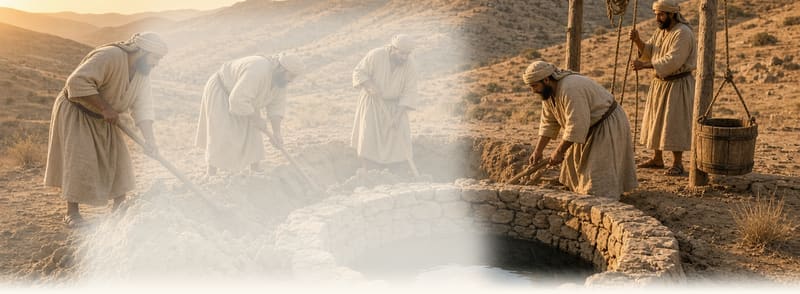
In Toldos, the Philistines have stopped up the wells that Avraham’s servants dug. Yitzchak reopens them and gives them the same names his father had given them. He does not invent the water. He removes what prevents it from flowing. Rabbi YY Jacobson puts the challenge plainly: after a father and grandfather dig wells and find water, those wells can later be plugged — and we have to re-dig them and find our own experience of Hashem, without changing the names. (Toldos: The Diplomat and the Digger, from about 42:20) He describes the division of labor: “Avraham Avinu generated the spark, the light”; “Yitzhak Avinu constructed the internal infrastructure for Judaism. He digs the well springs of Judaism.” (Toldos: The Diplomat and the Digger, from about 36:46) Rabbi Manis Friedman adds another layer: “Avraham introduced G‑d to the people”; Yitzchak worked “from the bottom up,” digging “in this place until you reveal its water,” so “the inspiration lasted longer. Because it was organic.” (Parshat Toldot: Why Yitzchak Loved Esav, from about 7:31)
Rav Haïm Dynovisz names what makes re-digging hard: “What bothers you is being only the one who receives what already existed before, and passing it on in turn.” The Jewish people endure by accepting to be “the link attached to tradition,” while also having “the duty to interpret” yesterday’s message “to find the answers to today’s problems.” (Toldot: “With the crafty, be crafty; with the upright, be upright”, from about 57:59; my English translation of his French)
Perhaps this offers an image for our spiritual history: Hashem guiding us to uncover the song of connection He has placed within us. Not everyone singing the same melody, but each person discovering how their own heart can turn fully toward Him in bittul.
1. Yitzchak’s merits — for Avraham’s sake, then his own
In Toldos, Hashem appears to Yitzchak twice with covenant language. The first time, in Gerar during the famine, He tells him not to go down to Egypt, promises to be with him and to give the lands, and grounds the oath in Avraham’s obedience: “because Avraham hearkened to My voice.” The second time, at Be’er Sheva, He says He will bless him and multiply his seed “for the sake of Avraham My servant.” (Bereishis 26:2–5, 26:24, with Rashi)
The promises are spoken to Yitzchak. The reason named for the covenant wording is Avraham’s merit. At the same time, Yitzchak’s own standing shapes how Hashem relates to him. Rashi, citing the Midrash, explains why he may not leave the Land: he is an olah temimah, a perfect burnt offering; what is offered that way does not leave its place. (Rashi on 26:2; Bereishis Rabbah 64:3; Genetics and Geography) Sforno reads the arc carefully: early favors come through Avraham’s merit; after Yitzchak builds an altar and calls in Hashem’s Name (26:25), Avimelech recognizes that he is blessed in his own right. (Sforno on 26:5)
Yitzchak’s own path is already visible elsewhere: he institutes Minchah from “Yitzchak went out to converse in the field toward evening”; his prayer for Rivkah is answered; he enters the covenant of the bris on the eighth day. (Why Do Jews Pray Three Times a Day?; Bereishis 25:21; The Contrast Between Yitzchak and Yishmael)
Chassidus gives the spiritual shape. Avraham’s service is chesed—going out, drawing down from Above. Yitzchak’s is gevurah—digging and uncovering within. That is why his wells lasted: what is revealed from below endures. (Why Yitzchak’s Wells Lasted; Likkutei Sichos — Toldos; Inwardness: The Path To Posterity) In the future, when Avraham and Yaakov do not answer for Israel’s sins in the same way, Israel turns to Yitzchak and says, “You are our father.” The Rebbe ties that Gemara to Toldos and to the laughter of redemption. (Shabbos 89b; Toldos 5744)
Two of our teachers add to this picture. Rav Dynovisz explains why the Torah says so little about Yitzchak: “since his true greatness is messianic, his true greatness will appear only at the end of days,” and “for now his true greatness is hidden.” (Toldot: “The Price of Gasoline!”, from about 8:51; my translation) Rabbi Reuven Wolf describes Yitzchak’s demands: “Yitzchak had very high standards… But precisely because of that, you became a much bigger vessel for intense blessings.” (Toldos – Veyiten Lecha Ha’elokim – 5728, from about 47:26)
In my understanding, this is the same movement as our song. First the melody is inherited “for Avraham’s sake”—a holiness we did not invent. Then, like Yitzchak at the wells, we uncover what is already within until the song can stand as our own service of Hashem.
2. A holiness we inherit
Chassidus associates Avraham with chesed—love and generosity; Yitzchak with gevurah—restraint and awe; and Yaakov with tiferes—compassion that brings kindness and strength together. These are distinct ways of serving the same Hashem. Tanya teaches that our hidden love for Him is an inheritance from the Avos. We begin with a connection deeper than anything we have consciously achieved. (Tanya, chapters 18 and 45)
The Imahos are essential to that inheritance. In Toldos, Rivkah inquires of Hashem about the struggle within her, and later acts so that the blessing reaches Yaakov. Our fathers and mothers establish not merely a family line, but a life of faith, discernment and service—a song of kedusha that sets a path toward the tzaddik’s service of Hashem.
We might describe these complementary paths as a song of kedusha. This is our contemplative image: love, awe and compassion finding their proper direction, rather than pulling the heart apart.
3. Removing what covers the heart
But an inheritance can remain hidden. A well may contain living water while its surface appears to be nothing but earth.
The Torah commands us to “circumcise” the heart. Rashi explains this as removing its covering and closure. Later, the Torah promises that Hashem Himself will circumcise our hearts so that we love Him with all our heart and soul. These passages give us both a responsibility and a promise: work against the heart’s resistance, and look toward the fuller opening that Hashem will bring. (Devarim 10:16; 30:6.)
In our musical image, removing that covering does not mean losing our individuality. It means that pride, stubbornness and distraction no longer determine what our individuality serves. Our particular gifts can become expressions of bittul—placing ourselves at Hashem’s service.
Rabbi Manis Friedman points to Yitzchak’s very name: “His name is Yitzchak, which means laughter… he is all about joy; that’s the joy that comes after humility.” First the limits are broken, and “once that finiteness has been broken, now you can handle infinity.” (Abraham vs Isaac, do they CLASH?, from about 19:15; and from about 9:42) In my understanding, that is the song of bittul: humility first, and then a joy that can finally sing.
4. When inheritance becomes song
At the Sea, the Jewish people sing two expressions together: “This is my G‑d” and “the G‑d of my father.”
The first expresses immediate recognition. The second acknowledges an inherited relationship. Rashi explains: “I am not the beginning of the sanctity.” What began with our forefathers has now become something their descendants personally recognize and sing.
Miriam and the women add another dimension. Rashi tells us that the righteous women brought tambourines from Egypt because they were confident that Hashem would perform miracles. Before liberation, they prepared for its song. Their faith made room for joy while they were still waiting. (Shemos 15:2, 20, with Rashi)
Here our image of history finds an explicit Torah song: inherited holiness becoming lived recognition, and recognition becoming praise.
5. What enters the ear reaches the heart
Not every moving melody directs us toward Hashem.
Rebbe Nachman teaches that hearing a worthy musician benefits our service of the Creator, while hearing a wicked musician can make that service harder. He describes the spiritual sources of melody through the image of pure birds and birds belonging to kelipah. The question is not simply whether the music excites us, but where it comes from and what it cultivates within us. (Likkutei Moharan I:3)
In my understanding, melodies rooted in the yetzer hara or tumah can pull the heart downward, while niggunim that come from tzaddikim can lift it toward Hashem. The difference is not “catchy versus boring,” but direction: toward kedusha or away from it.
This helps explain the place of niggunim in Chassidic life. Chabad teaching describes song as “the pen of the soul.” A niggun can express yearning that words cannot adequately contain. Singing a tzaddik’s melody offers a way to connect with the spiritual service expressed through it. (Music, Spirituality and Transformation) Rabbi Simon Jacobson likewise teaches that song is spiritual transportation for the soul—Divine language that can lift a broken spirit or bring a tear to a happy soul—and that we are meant to use that gift to refine our personalities and connect with our higher calling. (Sing; The Soul of Music)
Music can move us to tears—tears of happiness, sadness, melancholy or longing. Sometimes a melody reaches deep emotions more directly than words can. In my understanding, this touches the connection between nefesh and neshamah: the feelings we experience become an opening through which we sense something of the soul’s deeper life. A niggun directed toward Hashem can help turn that emotional awakening into yearning for Him.
Praying with a beautiful melody. Rashi reads “Honor Hashem with your substance” as “even from a pleasant voice.” (Rashi on Mishlei 3:9) The Shulchan Aruch asks for a chazzan “whose voice is pleasant,” and blesses one who lingers in song “because of the joy in his heart,” while warning against singing only to be heard. (Orach Chaim 53:4; 53:11) The Rebbe explained that in Rachamana “at first one beseeches G‑d with a broken heart,” and as the melody continues one is “filled with faith” and “becomes joyous.” (The Rebbe’s Melodies) Chabad.org’s Davening with a Nigun sets the Shabbos prayers to niggunim for “heartfelt and soulful davening.” The daily Tanya for 29 Cheshvan (Kuntres Acharon, beginning of Essay 3) contrasts prayer with and without kavanah: “Now, through intention in prayer, angels are created in the World of Beriah, as with intention in the study of Torah.” But “Without proper intent, [prayer] is repelled utterly downward.” (Lessons in Tanya, Kuntres Acharon, Essay 3) In my understanding, the melody of prayer aligns the heart, so that the intention becomes the proper one. In my understanding, this is why a beautiful prayer melody can bring us to tears, to joy, or to longing: it carries the nefesh toward the neshamah, so that the heart feels the words it is saying.
Kislev, which began this week, has the bow (keshet) as its sign, as noted in Sefer Yetzirah. According to the Midrash, this tells us that even if a person’s sins are like the poisonous bite of the scorpion, through prayer they can be catapulted to a better place; some associate this bow with the rainbow shown to Noach after the Flood. (12 Facts About the Month of Kislev, Fact 7) In my understanding, the bow of Kislev is prayer, which launches even the lowest things upward, and the melody that aligns the heart is what helps draw the bow, so that prayer rises as a song of bittul.
Our Sages teach that the Shechinah rests wherever Jews serve Hashem: with ten who pray, three who judge, two who learn, and even one who sits and learns. (Berachos 6a; Pirkei Avos 3:6) The Alter Rebbe explains that the light of the Shechinah needs oil, “meaning good deeds,” and that through a mitzvah it shines on the person “from head to foot.” (Tanya, ch. 35) When ten learn together, an individual “cannot be compared” to them in drawing down that light. (Iggeres HaKodesh 23) As Rashi says, “there is no comparison between a few who fulfill the Torah and many who fulfill the Torah.” (Rashi on Vayikra 26:8) One mitzvah can tip “the entire world to the side of merit.” (Hilchos Teshuvah 3:4) The Arizal teaches that every true convert’s soul stood at Sinai. (The Making of Converts) Rav Haïm Dynovisz teaches that converts are sparks drawn out by the light of Israel: « la présence de la lumière messianique dans le monde attire par le simple fait que elle existe toutes les étincelles qui lui correspondent ». (Vayera lecture, 34:06) In my understanding, wherever a Jew prays or does a mitzvah, the Shechinah shines around him in that place, and its light can rekindle the neshamah of other Jews, and even of future true converts. If this is true of one, it is all the more true of three and of ten: the more we are, the greater the light. Our Sages teach that the Shechinah rests on a person only through the joy of a mitzvah: when the minstrel played before Elisha, “the hand of Hashem came upon him.” (Shabbos 30b) The Zohar teaches that “song draws blessings from above to below,” and reads “Spring up, O well, sing to it” as Israel’s song raising the well to its place, the well that the Avos dug. (Zohar, Vayeilech) In my understanding, the Shechinah is the song that each of us, alone or together, reveals; it is part of revealing the light of Hashem in this world, the “abode in the lower realms” for which the world was created. (Tanya, ch. 36)
Related Chassidic teachings describe melody reaching beyond ordinary speech. Song is called the “quill of the soul,” and a chassidic niggun can express—or awaken—the soul’s innermost emotions, including yearning, joy and repentance, more eloquently than many words. (Hayom Yom, 13 Sivan; Music, Spirituality and Transformation) Rabbi Yitzchak Ginsburgh writes that deeper layers of the soul that cannot be put into speech can be heard in a deep niggun. (The Inner Melody of the Soul) A Zohar teaching presented on Chabad.org links the joy of music with drawing and elevating nefesh, ruach and neshamah together. (Glad Dad or Sad?) These sources support the broader experience that melody can open deep emotion and soul-yearning; the specific reading that emotion connects nefesh with neshamah remains my own understanding.
The Alter Rebbe’s Daled Bavos, with its four sections corresponding to the four spiritual worlds, gives musical expression to ascent. Tzamah Lecha Nafshi gives voice to the soul’s thirst for Hashem. Such yearning is not aimless sadness: it is longing directed toward the One we seek. (Daled Bavos; the Rebbe’s melodies)
In my understanding, some of the deepest niggunim hold past sadness together with future hope—the heart remembering exile while tasting redemption. I hear that blend as a taste of Or HaGanuz, the hidden light reserved for the righteous: intensity that can look dark until it is revealed as light. That reading of Or HaGanuz in music is my own; the classical teaching is that Hashem set apart a light for the righteous in the World to Come (see Rashi on Bereishis 1:4).
6. Seven notes, seven middos, and the eighth
Classical teachers repeatedly place music’s sevens beside the seven middos of the heart. Chabad.org notes that Kabbalah teaches seven building blocks of creation—six emotional attributes and Malchus—and that music has seven notes, A through G, while King David’s lyre had seven strings: “All these sevens are meant to bring to the eighth.” (Rise Above: Shine a Little Light) Another Chabad.org essay lists seven musical notes among the completed sevens of nature, beside the seven emotions refined in the Omer. (What is the Spiritual Significance of the Number Eight?) The Temple harp’s seven strings are explained as reflecting refinement of the seven middos; in the days of Mashiach the harp has eight. (Arachin 13b; King David’s Harp, citing Siddur im Dach)
Rabbi Yitzchak Ginsburgh teaches that the musical scale has seven basic notes corresponding to the completed natural order, and that the eighth note opens the next octave—above nature—just as the Temple’s seven-string instrument becomes eight in the days of Mashiach. (The Eighth Note; Who Knows Eight?)
In my understanding, music is mathematical too: harmony is proportion, and yofi is the language of Tiferes, the heart of the seven middos.
In my understanding, the shared seven is not a coincidence: each person’s—and each nation’s—song is a distinct blend of those middos, waiting to be uncovered as a song of kedusha. I am not presenting a fixed do=Chesed chart as classical Chabad teaching; that kind of note-by-note map is a later proposal and is not used here.
7. A melody can also be transformed
There is a further possibility: a tzaddik can redirect an outside melody into kedusha.
The Alter Rebbe adopted Napoleon’s March as a song of victory. Generations later, the Rebbe took a different melody—the French national anthem, La Marseillaise—and sang HaAderes VehaEmunah to it on Simchas Torah 5734 (Oct 19, 1973). He explicitly connected this act with the Alter Rebbe’s precedent. A melody associated with worldly revolution became an expression of praise to Hashem and a call to overcome the yetzer hara. (The Rebbe’s French Revolution)
These two melodies must be kept distinct: Napoleon’s March is not La Marseillaise. And for the historical record of 1974: under President Giscard d’Estaing the French anthem’s tempo and orchestration were changed; that is not the same as a claim that antisemitic words were removed from the lyrics. The spiritual teaching is about redirecting a melody’s force under the tzaddik’s direction—not about rewriting French politics.
The melody’s force was not merely discarded. Under the tzaddik’s direction, it was given a holy purpose—birur / ithapcha: kelipah redirected into kedusha.
Rabbi YY Jacobson sees the same hope in Yitzchak’s love for Esav: “within Esav there is deep light… Yitzchak wants to bless him in order to bring out those… sparks.” (To Find the Holiness in Eisav, from about 15:28)
8. Closing: the well is inherited
So we return to Yitzchak’s wells. Our fathers and mothers opened the way; our own work is to uncover what has become concealed and draw from it faithfully.
Perhaps, then, our history is not simply our search for the perfect song. It is Hashem guiding us toward the connection already waiting within—teaching us what to preserve, what to remove and what can be transformed.
The well is inherited. The drawing must become our own. And the heart, opened to Hashem, can finally sing.
9. Five styles in one demonstration
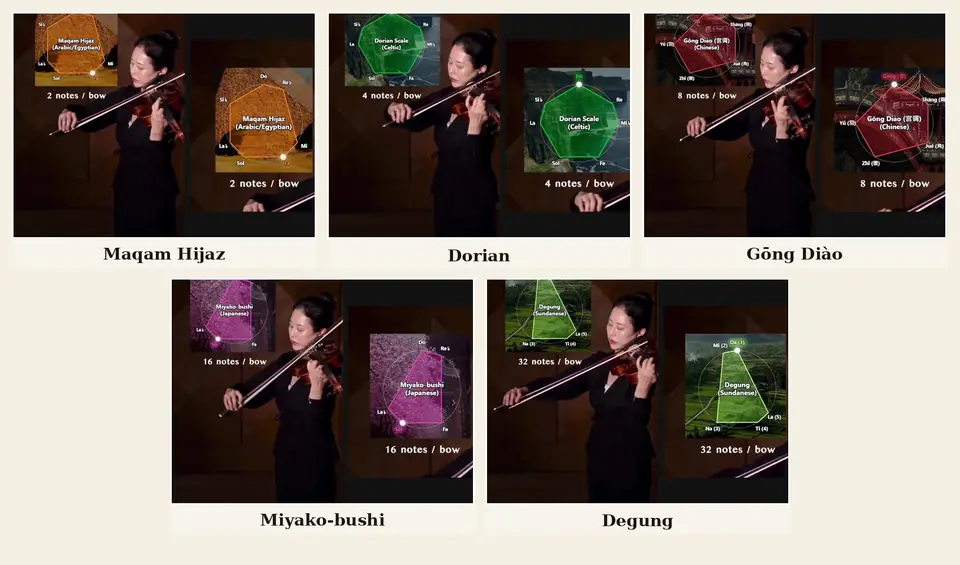
Each nation, like each Jewish tribe, has its own approach to connecting to Hashem: its own style, its own expression of its middos, its own song. A taste of this can be discovered through the distinctive styles of music in this violin demonstration I shared.
Today, the paths and songs of the nations are still clouded by kelipah. In the time to come, they will be purified, free of any trace of avodah zarah. In my understanding, that is when each nation’s own song can stand clearly before Hashem.
The prophet promises that Hashem will convert the peoples to a pure language, so that they all call upon His name and serve Him of one accord. (Tzefaniah 3:9) The Rambam teaches that Mashiach will improve the entire world, motivating all the nations to serve G‑d together, and he cites this very verse. (Hilchos Melachim 11:4) Rav Haïm Dynovisz teaches that the Deliverance is not for Israel alone: it takes “the whole of history,” “for us as for all the nations,” and “the humanity of the Deliverance is a humanity that has reached this unimaginable level.” (Toldot: “With the crafty, be crafty”, from about 59:13; my English translation of his French) Rabbi Reuven Wolf adds that in the days of Mashiach “we will be able to experience Hashem… everywhere we live, because the world will be pure and the power of Tumah that’s blocking us from experiencing Hashem… won’t be there anymore.” (Moshiach Matters 144 – A Broader Land, from about 26:16) These sources support the nations’ future purification toward the service of Hashem alone; the reading that their paths and songs are now clouded by kelipah remains my own understanding.
In another class, Rav Haïm Dynovisz teaches that at the final Deliverance “all idolatry will disappear from this world,” and that the Torah of Zion is “the Torah of humanity as a whole, where each nation will find its place inside the seventy facets of the Torah.” As he always says, this does not mean uniformity: “Unity has nothing to do with uniformity. Each nation will have its own approach, its own worship, its own way of understanding, living and feeling its approach toward G‑d.” Yet everyone will recognize that there is one unique G‑d, so as to reunite “the seventy-one facets in truth, seventy nations and Israel.” (La Délivrance viendra de France, from about 5:43, 6:47 and 7:43; my English translation of his French)
In my understanding, in their essence Yishmael and Esav are what our teachers describe: Yishmael is the chesed of kelipah and Esav the gevurah of kelipah. (Iggeres HaKodesh, Epistle 2, with its Lessons in Tanya elucidation) But through history, each one, trying to reach a balance, only pushed itself to the other extreme, evolving into a corrupted, unbalanced form of its father’s opposite middah: Yishmael today serves with an extreme, unbalanced gevurah, and Esav with an unbalanced chesed, both to the point of self-destruction. Yitzchak, holding Avraham’s chesed together with his own gevurah, knew how to do it right. In the World to Come, they too will reach a proper balance, and each nation will serve Hashem in its own way.
On screen, the same instrument moves through five named styles. Each segment shows a cultural landscape, a geometric map of the scale’s intervals, and a “notes / bow” label. The stills below are actual frames from that video—not reconstructions.
Watch the original video: https://x.com/xmuse_/status/2119503538912911528
Frames from the violin demonstration I shared; original post linked above. The styles, left to right then next row: Maqam Hijaz, Dorian, Gōng Diào, Miyako-bushi, Degung.
These frames help the eye notice how interval patterns and phrasing differ from style to style. That can open a contemplative analogy about how hearts express themselves differently. It is not a proof that cultures map onto middos ratios, nor a claim that one style is spiritually impure or inherently holy. The musical demo shows what the screen labels; our Torah reflection above remains a separate conversation.
Watch the demonstration
Original video: https://x.com/xmuse_/status/2119503538912911528. Frames from the violin demonstration I shared. Top row: Maqam Hijaz · Dorian · Gōng Diào. Bottom row: Miyako-bushi · Degung.
A contemplative analogy only
These frames help the eye notice how interval patterns and phrasing differ from style to style. Not a proof that cultures map onto middos ratios.

Torah and commentaries
- Bereishis 25:19–28:9 (Toldos); 1:4; 25:21; 26:2–5, 26:24–25
- Shemos 15:2, 15:20; Vayikra 26:8; Bamidbar 21:17; Devarim 10:16; 30:6; Tzefaniah 3:9; Mishlei 3:9
- Rashi on Bereishis 1:4; 26:2; Shemos 15:2, 15:20; Vayikra 26:8; Mishlei 3:9
- Sforno on Bereishis 26:5
- Bereishis Rabbah 64:3
Talmud and Midrash
- Berachos 6a; Shabbos 30b; Shabbos 89b; Arachin 13b
- Pirkei Avos 3:6
- Sefer Yetzirah (the bow as the sign of Kislev), as presented in “12 Facts About the Month of Kislev,” Chabad.org, Fact 7
Zohar and Kabbalah
- Zohar, Vayeilech (Sefaria, Vayeilech 9.47): “song draws blessings from above to below”; “Spring up, O well, sing to it”
- The Arizal, “The Making of Converts,” Chabad.org (every true convert’s soul stood at Sinai)
- Sefer Yetzirah, as above
Rambam and later authorities
- Rambam, Hilchos Teshuvah 3:4; Hilchos Melachim 11:4
- Shulchan Aruch, Orach Chaim 53:4; 53:11
Chassidus and the Rebbe
- Tanya, chapters 18, 35, 36 and 45; Iggeres HaKodesh, Epistle 2 and Epistle 23; Kuntres Acharon, Essay 3 (Lessons in Tanya; daily Tanya for 29 Cheshvan)
- Likkutei Sichos — Toldos; “Inwardness: The Path To Posterity” (In the Garden of the Torah, Toldos); Shabbos Parshas Toldos, 29 MarCheshvan 5744
- Hayom Yom, 13 Sivan
- The Rebbe’s Melodies; “The Rebbe’s French Revolution,” Chabad.org (HaAderes VehaEmunah to La Marseillaise, Simchas Torah 5734)
- “Why Yitzchak’s Wells Lasted”; “Genetics and Geography”; “Why Do Jews Pray Three Times a Day?”; “The Contrast Between Yitzchak and Yishmael”; “Music, Spirituality and Transformation”; “Davening with a Nigun”; “12 Facts About the Month of Kislev”; “Rise Above: Shine a Little Light”; “What’s the Significance of the Number Eight?”; “King David’s Harp” (citing Siddur im Dach); “Glad Dad or Sad?” — all Chabad.org
- Daled Bavos; Tzamah Lecha Nafshi
- Rebbe Nachman, Likkutei Moharan I:3
Teachers and online sources
- Rav Haïm Dynovisz, Toldot: “With the crafty, be crafty; with the upright, be upright” (YouTube ncRqJ4Bs8Kg, about 57:59 and 59:13)
- Rav Haïm Dynovisz, Toldot: “The Price of Gasoline!” (YouTube rD5QcAfRYEo, about 8:51)
- Rav Haïm Dynovisz, Vayera lecture on the origin of souls (YouTube 3U4Jzb6hUuQ, 34:06)
- Rav Haïm Dynovisz, La Délivrance viendra de France (YouTube Sc0LIbFPAY4, about 5:43, 6:47 and 7:43)
- Rabbi YY Jacobson, “Toldos: The Diplomat and the Digger”; “To Find the Holiness in Eisav”
- Rabbi Manis Friedman, “Parshat Toldot: Why Yitzchak Loved Esav”; “Abraham vs Isaac, do they CLASH?”
- Rabbi Reuven Wolf, “Toldos – Veyiten Lecha Ha’elokim – 5728”; “Moshiach Matters 144 – A Broader Land”
- Rav Yitzchak Ginsburgh, “The Inner Melody of the Soul”; “The Eighth Note”; “Who Knows Eight?” (inner.org); “The Secret Hidden in the Golden Ratio” (YouTube short)
- Rabbi Simon Jacobson, “Sing”; “The Soul of Music” (meaningfullife.com)
Music and cartoons
- Violin demonstration post on X — x.com/xmuse_/status/2119503538912911528
- Heimish Humor (cartoon), Shared by Rabbi Haim Tebeka
Also cited in this sheet
- Closing note of this shiur (analogy disclaimer) · this shiur
|
|
|