

Parshat Vayeira
Download the sheet
Full PDF Short PDF (4 pages) Full PDF in French Short PDF in French (4 pages) Share your feedback

A Breath of Hashem, and the Light It Is Meant to Show
1. A Spark of Hashem Inside
When Hashem (G‑d) formed Adam, He did not speak him into being the way He spoke the light or the seas. “He breathed into his nostrils the soul of life” (Bereishis [Genesis] 2:7). The Alter Rebbe (Rabbi Schneur Zalman of Liadi, founder of Chabad and author of the Tanya, the basic text of Chabad Chassidus) teaches that this soul is “truly ’a part of G‑d above’,” chelek Eloka mima’al mamash (Tanya ch. 2). I have long explained it this way: because Hashem breathed a part of Himself into us, we have chochmah, binah and daas (wisdom, understanding and knowledge), and so we too can bring something new out of nothing, a thought or an idea that did not exist before, as Hashem creates out of nothing. Artificial intelligence, for all its brilliance, derives something from something: it builds new from what already exists. That is very valuable, but it is a different kind of creating.
Something follows from this. A soul that is a part of Hashem will always seek its Source, the way a flame always reaches upward. Avraham was the first to show this. The Rambam (Maimonides, the 12th-century sage who wrote the Mishneh Torah) describes him as a child who began to wonder, and stresses: “He had no teacher, nor was there anyone to inform him.” He worked his way to the truth on his own, and “Avraham was forty years old when he became aware of his Creator” (Hilchos Avodas Kochavim 1:3). The Gemara (the Talmud) goes further: “Avraham recognized his Creator at the age of three” (Nedarim 32a). Rabbi YY Jacobson adds a striking thought. Even before Avraham found the truth, his search was already holy: “Underlying Avraham’s fiery idol worship was a soul yearning for the one living G‑d” (theyeshiva.net, Ki Sisa essay).
And if that yearning was strong enough to carry Avraham all the way to Hashem, we have to ask what gets in its way for the rest of us.
2. When the Ego Becomes an Idol
That yearning is in every one of us. But the ego and the yetzer hara (the evil inclination) can take that very drive and point it somewhere else, at an idol in place of Hashem. Today the pull has only grown stronger. We tend to believe our success is our own work, or the work of our education and our fancy diplomas. The Torah warned us long ago: “and you will say to yourself, ’My strength and the might of my hand that has accumulated this wealth for me.’ But you must remember the L‑rd your G‑d, for it is He that gives you strength to make wealth” (Devarim [Deuteronomy] 8:17–18). Rav Haïm Dynovisz says it bluntly: « l’idolâtrie c’est quoi c’est l’homme qui se prosterne devant sa propre réussite », idol worship is man bowing down before his own success. It is « le culte de l’ego », the cult of the ego. Avraham shows us the way out, right here in our parsha: pleading for Sedom, he says, “although I am dust and ashes,” ve’anochi afar va’efer (Bereishis 18:27). Rabbi Yitzchak Ginsburgh puts it this way: “We naturally want to feel significant. Yet one of the deepest spiritual states is to experience oneself as dust. When the ego becomes small, we become more connected to the Source from which everything comes” (X, Oct 28, 2026, https://x.com/RabbiGinsburgh/status/2115512924848476357). He ties it to the words we ask for at the end of every Amidah, “may my soul be as dust to all,” and explains: “when I experience myself as being actually dust… thereby I connect to the source of creation and to the purpose of creation.” That is the very opposite of kochi ve’otzem yadi: whoever feels like dust knows that the strength to succeed comes from Hashem. And our Sages teach that as a reward for those words, “And I am but dust and ashes,” Avraham’s children merited two mitzvos, the ashes of the red heifer and the dust of the sotah (Sotah 17a). The ego can slip in even when we are doing good. Rabbi Manis Friedman tells of a father who said, “I’m so busy taking care of my kids, I have no time for my kids,” and answers: “Don’t be a good father, because then it’s all about you. Just be a father.” I would add: just be a father… that does good. As Rabbi Friedman puts it, “Don’t become it, do it.”
How can we tell when this is happening to us? I believe the clearest sign is anger. The Gemara says that one who tears his clothes, breaks his dishes or throws away his money in anger “should be like an idol worshipper in your eyes, as that is the craft of the evil inclination” (Shabbos 105b). The Rambam rules: “Anyone who becomes angry is like one who worships idols” (Hilchos De’os 2:3). And the Alter Rebbe explains why: “at the time of his anger faith has departed from him. For were he to believe that what happened to him is of the L‑rd’s doing, he would not become angry at all” (Iggeres HaKodesh, the letters section of the Tanya, 25). Rabbi Manis Friedman puts it simply: “by allowing ourselves to become angry, we fail to acknowledge that everything comes from G‑d” (chabad.org, “Humility and Anger”). Rav Dynovisz reaches the same place from his own direction: « l’idolâtrie et la colère sont liés », idol worship and anger are bound together. This is the point I most want us to take home. If everything comes from Hashem, then everything is, by definition, for our good, even when it looks bad to us. Our Sages speak of the Or HaGanuz, the hidden light of the first day, which Hashem “concealed” and stored “for the righteous people in the future” (Chagigah 12a; Rashi, the classic commentator on the Torah and Talmud, on Bereishis 1:4). I understand it as a light so intense that it blinds, which is why so many events, in our own lives and in the world, look negative when they are really positive: the good is hidden inside the seemingly bad. The Alter Rebbe says exactly this: “no evil descends from above and everything is good, though it is not apprehended because of its immense and abundant goodness” (Iggeres HaKodesh 11). That is why the Talmudic sage Nachum Ish Gamzu would say of whatever happened to him, “This too is for the good” (Taanis 21a). Anger is the moment we forget all this.Translation: “idol worship and anger are linked”
Is this only a beautiful idea? Let us open our parsha and see the hidden good at work.
3. Four Hands for Four People
We can see this hidden good right in our parsha, inside its harshest story, the destruction of Sedom (Sodom). When Lot lingered, “the men took hold of his hand and his wife’s hand, and the hand of his two daughters, out of the L‑rd’s pity for him, and they took him out and placed him outside the city” (Bereishis 19:16). I have always wondered: two angels have only four hands, so how did they hold four people? Look closely, and the Torah says yad, one hand, each time, even “the hand of his two daughters.” The Chibbah Yeteirah (Rabbi Yehuda Herzl Henkin, a contemporary Orthodox commentator) counts it exactly: «ארבע ידים לארבעתם», four hands for the four of them. The Birkat Asher (Rabbi Asher Wassertheil, also a contemporary Orthodox commentator) explains that one angel held Lot and his wife, and the other held the two daughters. The Malbim (the 19th-century Torah commentator) sees it the other way: they took him out «בדרך הפלא», in a wondrous way, so that in an instant he was outside the city.
That raises a second question, and here is my own answer. Rashi teaches that one angel never carries out two missions (Rashi, Bereishis 18:2), and the Midrash (the Sages’ teachings on the Torah) names them: Gavriel was sent to overturn Sedom and Refael to rescue Lot (Bereishis Rabbah 50:2). So only the rescuing angel should have taken them out, unless taking them out was itself a step needed to destroy Sedom. And it was. The angel tells Lot, “Hasten, flee there, for I will not be able to do anything until you arrive there” (Bereishis 19:22). This is the line of the Midrash and Rashi, and Tosafos (the medieval commentators on the Talmud, Bava Metzia 86b), the Ohr HaChaim (Rabbi Chaim ibn Attar) and the Gur Aryeh (the Maharal of Prague’s commentary on Rashi) say it outright: both angels brought the family out of the city, but only one was the rescuer. That is why, Rashi notes, the Torah then says “and he said: Flee…,” and not “and they said” (Rashi, Bereishis 19:16). The Tur HaAroch (Rabbi Yaakov ben Asher’s Torah commentary) spells out the reason: since the destroyer could do nothing until Lot was saved, the rescue was needed for the destruction itself. The very mission that destroyed also saved. And for whose sake? “G‑d remembered Avraham, and He sent Lot out of the midst of the destruction” (Bereishis 19:29). As Rashi puts it, “in Avraham’s merit you are saved” (Rashi, Bereishis 19:17). Even inside the judgment, Hashem’s kindness was there, for Avraham’s sake.
What gave Avraham’s merit such power? I believe it is what Hashem placed in each of us: a soul that can truly turn to Him and to another person.
4. A Soul, Not a Machine
This week Rabbi Ginsburgh, speaking about AI, gave words to what makes us different: “The human being is a subject. He’s not an object. AI is an attempt to make an object subjective. But it will not ultimately succeed.” AI, he says, should teach us “that the ultimate subject, which is the ability to truly relate to another and truly to relate to our Creator, to G‑d, that’s unique to the human soul.” Ego and anger are exactly what cover up that ability.
So what is our task? As I see it, Avraham’s mission, and the mission of the Jewish people after him, is to reveal Hashem’s light, and to chase the darkness by showing light rather than by fighting it. Rabbi Ginsburgh, reading the first verses of the Torah, describes how the world first looks to us: “darkness was over the face of the abyss.” Then comes hope, and then: “Light is the ability to see, to recognize that all is for good (and G‑d saw the light to be good), for the individual and for all; let there be light for all, and there was light for each and every individual.” That is the light Avraham came to reveal, the hidden light coming out into the open: behind our successes and our setbacks alike stands Hashem, and all of it is for good.
Revealing that light, though, takes more than good wishes. It takes balance, and Avraham shows us how.
5. Kindness With a Backbone
But showing light does not mean wishing the darkness away. When the world shows us a cruel face, there is a natural pull to live as if we were already in the World to Come, a “Disney-movie” world where every wolf is already a lamb. As I see it, that is rushing it, reaching for it too early, before human nature has healed; and kindness that is not balanced does not hold. Our parsha teaches this. Avraham was chesed (lovingkindness) itself, yet the Zohar (the classic text of Kabbalah) says of the Akeidah (the binding of Yitzchak): “Until this point, Avraham was not complete. Now water was blended with fire” (Zohar I 119b). His kindness took on gevurah (disciplined strength), and the angel could finally say, “Now I know that you fear G‑d” (Bereishis 22:12). Yitzchak, the man of gevurah, went on to dig wells of living water. Each carried the other’s middah (character trait). And if anything, I believe Yitzchak’s gevurah toward Yishmael is what helped Yishmael grow: by Avraham’s passing, Yishmael “repented of his evil ways … and yielded the precedence to Yitzchak” at the burial (Rashi, Bereishis 25:9; Bava Basra 16b).
I noticed something else in our parsha that I want to share with you. Sarah is taken by Avimelech (Bereishis 20), comes home untouched, and right away “the L‑rd remembered Sarah” (21:1), just like the innocent sotah (a wife wrongly suspected, who drank the “bitter waters” to clear her name), who is promised: “she shall be cleared and shall conceive seed” (Bamidbar 5:28). Then I discovered that Rabbi Yitzchak in the Midrash had already taught it, long before me: “This one, who entered the house of Pharaoh and the house of Avimelech and came out pure, is it not only right that she be remembered?” (Bereishis Rabbah 53:6). One view there adds that Yitzchak was born at nine months, “so that people should not say: he was scooped out of Avimelech’s house.” Chizkuni, Kitzur Baal HaTurim, Lekach Tov and Siftei Kohen (on 21:1) agree. Chizkuni: “Sarah was secluded and was not defiled.” Pharaoh didn’t count, explains the Kitzur Baal HaTurim, since only Avimelech actually reached out to touch her. The Ohr HaChaim (12:13) goes further: Avraham intended it. Like Chana, ready to be tested as a sotah, for “You will not make Your Torah false” (Berachos 31b; whether a barren wife then conceives is a Tannaitic dispute), “Avraham thought that through the woman’s seclusion with the man while she is innocent, the L‑rd would remember her with children.” It worked “with Avimelech, and not this time with Pharaoh.”
Avimelech gave Sarah kesus einayim, “a covering of the eyes,” public proof of her innocence: “they will know that I returned you against my will, and through a miracle” (Rashi 20:16). And Avraham prayed for Avimelech’s household: “whoever asks for mercy for his fellow while he needs the same thing is answered first” (Rashi 21:1; Bava Kamma 92a). To me this is kindness with a backbone at its clearest: the gevurah of the sotah’s harsh test, and of Sarah’s seclusion, gives birth to chesed, a child. And look which child: Yitzchak, whose own middah is gevurah, the “Pachad Yitzchak” (the “Fear of Yitzchak,” Bereishis 31:42), of whom the Alter Rebbe writes: “In [Yitzchak]’s mode of Divine service, the fear is manifest while the love is hidden in a state of concealment and hiding” (Tanya, Iggeres HaKodesh 13). This twist is my own: gevurah gave birth to chesed, and that chesed came into the world as a man of gevurah. The Rebbe teaches that Avraham’s humble “I am dust and ashes” (18:27), as we saw, brought “the dust of the sotah,” where even the bitter waters, gevurah (strictness), “perform an act of chesed (kindness): ’she shall be cleared and shall conceive seed’” (Likkutei Sichos vol. 25, Vayeira 2).
And this brings us right back to the ego. The Alter Rebbe explains that holy chesed shows itself in humility, like Avraham saying, as we saw, anochi afar va’efer (“I am dust and ashes”), while unbalanced chesed has a counterfeit. Yishmael is “’chesed of kelipah’: the more kindness (manifested to him), the more he grows in pride, haughtiness, and self-satisfaction” (Tanya, Iggeres HaKodesh 2), kelipah being the husk that hides holiness. Our Sages warn: “Anyone who becomes compassionate when he should be cruel will ultimately become cruel when he should be compassionate” (Koheles Rabbah 7:16). And the Rambam reminds us that even in the days of Mashiach (the Messiah) “the world will continue according to its pattern,” and that the wolf dwelling with the lamb is “a metaphor and a parable” (Rambam, Hilchos Melachim 12:1). Only “in the future, at the end of days, G‑d will bring the evil inclination and slaughter it” (Sukkah 52a). So we don’t pretend. “Today to do them” (Eruvin 22a): today is for Torah, mitzvos (commandments) and kindness with a spine. Israel went to the polls this week, with final results due November 4, and America votes on November 3. Watching this season’s elections, in Israel, here and abroad, I see how deeply people long for that better world. The longing is holy; let it move our hands, not cloud our eyes.
And while we wait and work for that day, there is something we are allowed to ask for.
6. Good We Can See
I want to add something I feel strongly about. Even while we understand that everything is good, we do not have to ask for the hidden kind. We pray to experience only revealed good, tov hanir’eh v’haniglah, good that we can see with our own eyes. There is no need for us to go through the harshness of the world to get there. The Rebbe (the Lubavitcher Rebbe, Rabbi Menachem Mendel Schneerson) spoke about this many times. He taught that when we recognize hardships as hidden kindness, “the inner truth and ultimate source of what appears as hardships will be revealed even at present and G‑d will grant us all revealed goodness,” and that in the Redemption, “with our own eyes, we will see G‑d’s kindness in revealed and manifest goodness,” in the Rebbe’s own words b’tov hanir’eh v’haniglah (Likkutei Sichos, the Rebbe’s collected talks, vol. 19, Re’eh 1).
People sometimes ask me about the hard road the prophets describe before the Redemption, and here I want to share an idea of my own. Last week we read of Avraham’s war against the four kings (Bereishis 14), and our Sages see in it a preview of the end of history. The Ramban writes: “This event happened to [Avraham] in order to teach us that four kingdoms will arise to rule the world. In the end, his [Avraham’s] children will prevail over them” (Ramban, Bereishis 14:1). And the Midrash teaches: “If you see kingdoms clashing with one another, you should anticipate the coming of the Messiah. You may know that it is so, as in the days of [Avraham], as a result of the kingdoms clashing with one another, redemption came to [Avraham]” (Bereishis Rabbah 42:4). Our own parsha adds a link. For the end of days, the prophet Yechezkel foretells the war of Gog uMagog: Gog, king of the land of Magog, coming up against the Jewish people in the Land of Israel (Yechezkel 38–39). The “sulfurous fire” that Hashem rained on Sedom (Bereishis 19:24) is the very phrase Yechezkel uses for Gog: “sulfurous fire upon him and his hordes” (Yechezkel 38:22). And the Midrash says that Gog uMagog will come up against Yerushalayim three times (Midrash Tehillim 118:12).
Now put two “threes” side by side. Our Sages tie the three Batei Mikdash (Holy Temples; singular, Beis HaMikdash) to our three Avos (Patriarchs): Avraham called the site har, a mountain; Yitzchak, sadeh, a field; and Yaakov, bayis, a house (Pesachim 88a). The Rebbe explains: “the First Beis HaMikdash is representative of Avraham; the Second Beis HaMikdash is linked to Yitzchak; while the Third Beis HaMikdash corresponds to Yaakov… the attribute of Yaakov is truth, and truth will never be interrupted or changed” (Kuntres Shabbos Matos-Masei 5722, Sefer HaMaamarim Meluket IV). This is my own idea: just as there are three Batei Mikdash, I see three great wars that shake the whole world, the third being Gog uMagog, as the road that leads to the Third and eternal House. I have not found it in these words in any source; I offer it as a remez (a hint), not a prediction. The Ramban, on Yitzchak’s three wells, points the same way: the first well hints at “the First House, concerning which the nations contended with us and instigated quarrels and wars with us until they destroyed it,” while the third, [Rechovos], “is a reference to the Future House, which will be speedily built in our days, and it will be done without quarrel and feud” (Ramban, Bereishis 26:20).
But I want to be careful, as our Sages are. The Rambam teaches about the war of Gog uMagog: “All these and similar matters cannot be definitely known by man until they occur” (Hilchos Melachim 12:2), and we are not to calculate the end. What we do know is how the Rebbe met frightening times. In 5751 (1990–91), when many were afraid, he “gave the widest possible publicity” to the words of the Yalkut Shimoni (Yeshayahu 499): “My children, have no fear. Whatever I have done, I have done only for your sake. Why are you afraid? Have no fear: the time for your redemption has arrived!” And our Sages give each of us a shield at our own table: “Anyone who fulfills the obligation to eat three meals on [Shabbos] is rescued from three punishments… and from the war of Gog and Magog” (Shabbos 118a). So this is what I pray for: not the war, but the Third House, Yaakov’s house of truth, built “without quarrel and feud,” in good we can see.
That is where the whole story is heading. The Gemara asks about the verse “on that day shall the L‑rd be one and His name one,” the words we say at the end of Aleinu (the prayer that closes each service): “Is that to say that now He is not one?” And it answers: “In this world, upon good tidings one recites: Blessed…Who is good and does good, and over bad tidings one recites: Blessed…the true Judge. In the World-to-Come one will always recite: Blessed…Who is good and does good” (Pesachim 50a). Rashi reads the Shema (our daily declaration of Hashem’s Oneness) the same way: “The L‑rd who is now our G‑d… He will at some future time be the One (sole) [L‑rd]” (Rashi, Devarim 6:4). Then the Shema will be fully revealed, and Hashem Echad uShmo Echad (Hashem is One and His Name is One) will be true for everyone to see. The Torah promises: “And the L‑rd, your G‑d, will circumcise your heart” (Devarim 30:6). The Ramban (Nachmanides, the 13th-century Torah commentator) explains that “lust and desire are the ’foreskin’ of the heart,” and that “in the days of the Messiah, the choice of their [genuine] good will be natural.” As I understand it, a circumcised heart is a heart whose ego has been tamed, so that nothing stands between us and the good, and everyone sees it. That was Avraham’s ultimate vision and goal. Right here in our parsha (this week’s Torah portion) he planted his eshel, his place of hospitality: according to one view in the Gemara it was an orchard to supply fruit for his guests, and according to the other an inn for lodging (Rashi, Bereishis 21:33). There he brought his guests to bless Hashem, and the Gemara says that through it “Avraham our forefather caused the name of the Holy One, Blessed be He, to be called out in the mouth of all passersby” (Sotah 10a–b, on Bereishis 21:33).
Our teachers this week fill in the picture. This Shabbos is Chof Cheshvan, the birthday of the Rebbe Rashab (Rabbi Sholom DovBer, the fifth Lubavitcher Rebbe), who as a little boy cried because Hashem revealed Himself to Avraham and not to him. Rabbi Reuven Wolf, following that same line of the Rebbe’s teaching, explains that Avraham’s pain after his bris was a longing for the highest level, the fiftieth gate, and that in His visit “Hashem actually illuminates [Avraham Avinu’s] soul with the 50th level and that’s the healing.” Rabbi Shalom Arush reminds us that “where the eyes of the person are, that’s where the person is,” and that “being stingy is being the opposite of Hashem,” even with words. And Rabbi Simon Jacobson, teaching Tanya ch. 37, calls every mitzvah “a building block” of the Geulah (the Redemption): “We’re not bystanders.” Hagar learned it at the well: the water was there all along, and she only had to lift her eyes and see it.
May we credit every success to the One who gives us the strength, meet every frustration with faith instead of anger, and so add light to our homes and to the world. May Hashem show us only good that we can see, revealed and visible good; may He circumcise our hearts so that the ego no longer hides the light; and may we live to see Avraham’s goal fulfilled, when Hashem is One and His name is One, with the coming of Mashiach, speedily in our days.
Hagar’s Well: The Water Was Already There
Hagar and [Yishmael] are lost in the desert, the water is gone, and she sits a bowshot away so she won’t have to watch him die. Then G‑d “opened her eyes, and she saw a well of water” (Bereishis 21:19). Rabbi Eliezer Shemtov points out that the Torah doesn’t say a well appeared. She saw one that had been there all along, and what changed was how she looked. The angel told her, “Arise, lift up the boy and hold him by the hand” (21:18). In other words, raise your gaze and don’t stop at the empty canteen. As Rabbi Shemtov puts it: “Success depends on G‑d; the effort depends on you.”
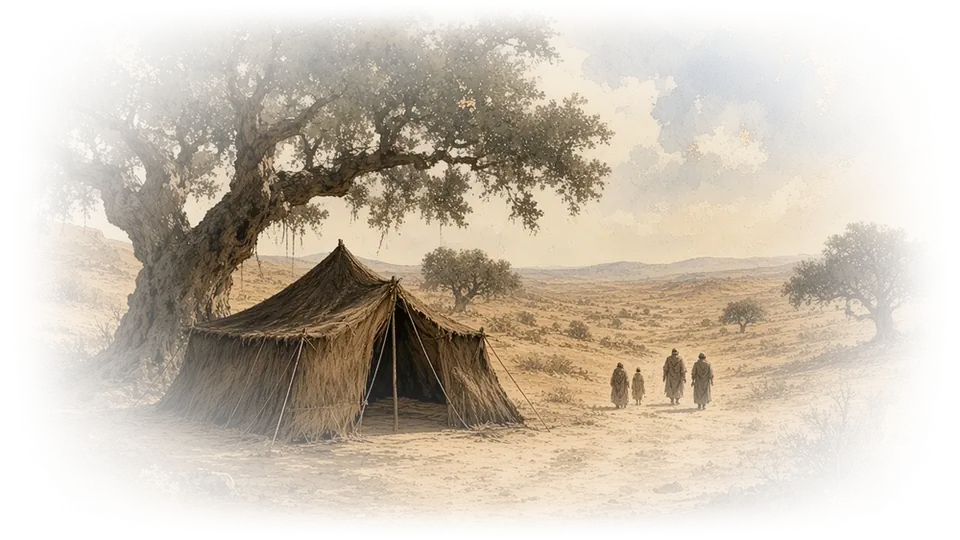
Avraham’s road runs both ways
Hashem says of Avraham: “I have loved him, because he commands his children and his household after him, that they keep the way of Hashem, doing charity and justice” (Bereishis 18:19). In a ma’amar on the Rebbe Rashab’s birthday, Shabbos Vayeira 5737, the Rebbe explains “the way of Hashem” like a king’s road: “through the medium of the road a connection and bond is brought about between the remote corners of the land and the place where the king resides.” And a real road runs both ways. When we learn Torah, Hashem’s wisdom comes down to us; when we do mitzvos, especially the hard ones, we go up.
Even the giving has a rule: “one must judge what is in excess to himself and consider what is necessary to his life and give the rest to charity.” That effort from below is what Avraham was known for: “to Avraham there was a revelation of this aspect, through his work in the way of the rebounding light (Ohr Chozer) from below to Above.” And it did not stay with him: Avraham’s command “is a special empowerment … to each and every Jew in regard to the two above-mentioned kinds of service.”
Sick with longing: why Avraham hurt after the bris
Rashi says G‑d came “to visit the sick” on the third day after Avraham’s bris (Bereishis 18:1). But a mitzvah should bring a person to perfection, so why did it make him sick? The Rebbe brings the Tzemach Tzedek (the third Lubavitcher Rebbe): “the source of sickness is the soul’s being lovesick out of a desire to cling to G‑d. [The Hebrew word for sick חולה is numerically equivalent to 49. There are ’50 gates of understanding in the world.’ Thus, when a person has acquired only 49, he becomes sick, yearning for the completion he lacks.] The remedy for this sickness is the revelation of G‑dliness.” Avraham had reached what “a creation can achieve with its own efforts”; the fiftieth gate only G‑d can give, and that is the visit of vayeira eilav, “G‑d appeared to him.” That is also why a five-year-old Rebbe Rashab wept: the same lovesickness. The Rebbe’s directive for a Shabbos Vayeira that falls on 20 Cheshvan, as this one does: “each one of us should think over the story of the Rebbe Rashab’s crying and realize that regardless of the level he has already reached, he must strive to reach an even higher rung.”
The eishel: kindness beyond reason
“And Avraham planted an eishel” (Bereishis 21:33): a tree, an orchard, an inn with food, drink and lodging for absolute strangers (Bereishis Rabbah 54:6). “Within the heart of every Jew has been implanted the attribute of charity and the desire to perform deeds of kindness. This is our heritage from Avraham our Patriarch – not merely to provide others with their bare necessities, but rather to enable them to derive pleasure.” And right after the eishel comes the Akeidah, because “The power of mesirus nefesh [self-sacrifice] that motivated Avraham and Yitzchak to carry out the Akeidah came from the eishel that Avraham planted, i.e., from his willingness to do good and spread kindness in a manner that transcends logic and reason.”
Avraham opened the pipeline
Why is the Akeidah, and not Avraham’s earlier risks, the root of all Jewish self-sacrifice? Because nobody saw it, and it destroyed his own life’s work in the eyes of logic: “The self-sacrifice to perform the Akeidah had no basis in logic. It was motivated solely by Avraham’s commitment to carry out G‑d’s will. This represents a complete expression of bittul.” And so “he endowed every Jew with the potential for true and utter mesirus nefesh, making this the true deep inner will of every Jew.” For each of us: “Whenever a Jew labors to conquer his personal desires and performs an act in G‑d’s service, it is like Avraham is leading him to the Akeidah.”
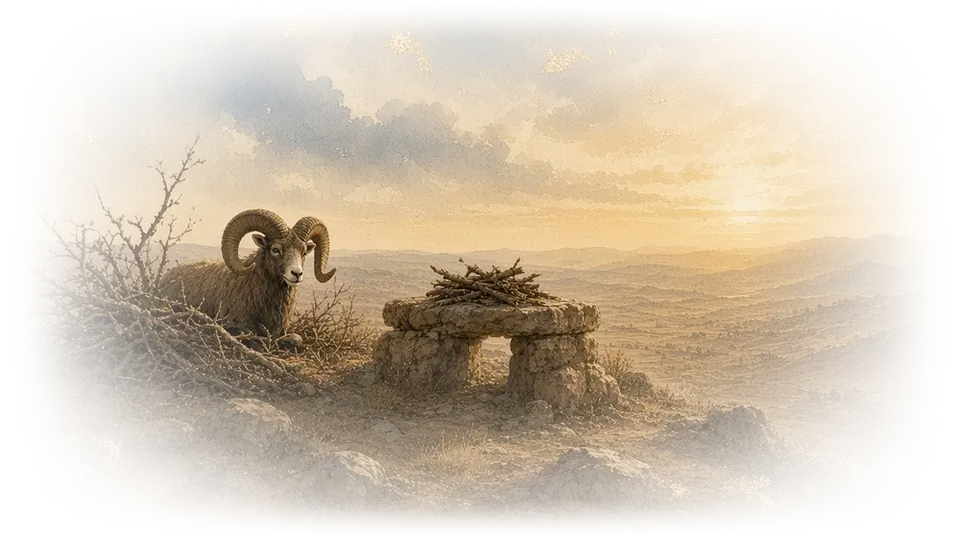
Chesed means taking the first step alone (28:40–33:02; 51:19)
Everyone “knows” Avraham as the man of chesed (kindness). Rav Dynovisz sets out to redefine the word. First: « Il n’y a pas un acte de récède plus grand que d’être le premier et le seul à faire quelque chose qui va bouleverser l’humanité tout entière. » (the captions hear chesed as « récède » or « recette »). And: « Le recette, c’est être capable de faire le premier pas tout seul. » Yitzchak had Avraham behind him, and Yaakov had two generations; Avraham had no one. So, on olam chesed yibaneh, “the world is built on kindness” (Tehillim 89:3): « le monde se construira grâce à tous ceux et à toutes celles qui ont le courage la foi d’être les premiers et peut-être même souvent les seuls »Translation: “There is no greater act of chesed than being the first and only one to do something that will overturn all of humanity.” · “Chesed is being able to take the first step alone.” · “the world will be built by all those, men and women, who have the courage and faith to be the first, and perhaps often even the only ones”
Never despair of a person (43:14–49:42)
The second definition. Noach’s model was that the righteous are saved and the wicked perish; Avraham would not accept it: « dans chaque homme se cache véritablement une lumière qu’il faut simplement dévoiler ». « Le monde n’a pas été créé pour les justes uniquement. Le monde a été créé pour tout le monde ». « Abraham est le premier homme qui ne se désespère pas des hommes. Et ça c’est le récède. » « Le récède encore une fois c’est la confiance en l’homme. Ne jamais se désespérer de l’homme, y croire jusqu’au bout. » His proof is Eliezer, by tradition the son of Nimrod, who became Avraham’s faithful servant: « il montre qu’on peut sortir l’étincelle divine de partout ».Translation: “in every person a light is truly hidden that simply needs to be revealed” · “The world was not created only for the righteous. The world was created for everyone.” · “Avraham is the first man who does not despair of people. And that is chesed.” · “Chesed, once more, is trust in man. Never despair of a person; believe in him to the end.” · “he shows that the divine spark can be drawn out of anywhere”
The bargaining over Sedom is a code (52:00–01:04:23)
Avraham’s plea for Sedom, from fifty tzaddikim (righteous people) down to ten (Bereishis 18:24–32), reads in his telling like a code. Fifty stands for ha-adam, the true man: « Abraham dit à Hashem, fais-le pour l’homme. » Forty-five is just a human being; forty, the days in which an embryo forms, people who could still become human; thirty is lamed, learning, people who would change if taught; twenty hints at Keser, the indestructible spark; and ten is yud, the first letter of the Name: “do it for Your own sake.” (His reading, in summary.) And it worked, over time. From Sedom came Lot, then Moav, Rus, David and Mashiach: « Il a réussi dans sa prière. Il a tout réussi. » On “I have found David My servant” (Tehillim 89:21): « L’âme du Messie était perdue à cedomme et là-bas, elle a été récupérée. Ce dire que même de la poubelle du monde est sortie la lumière du monde. » His personal close: « Mais ne jamais se désespérer de la globalité. ».Translation: “Avraham says to Hashem: do it for man.” · “He succeeded in his prayer. He succeeded in everything.” · “The soul of Mashiach was lost in Sedom [the captions say « cedomme »], and it was recovered there. That is to say, even out of the world’s garbage came the light of the world.” · “But never despair of the whole.”
A smile for the table
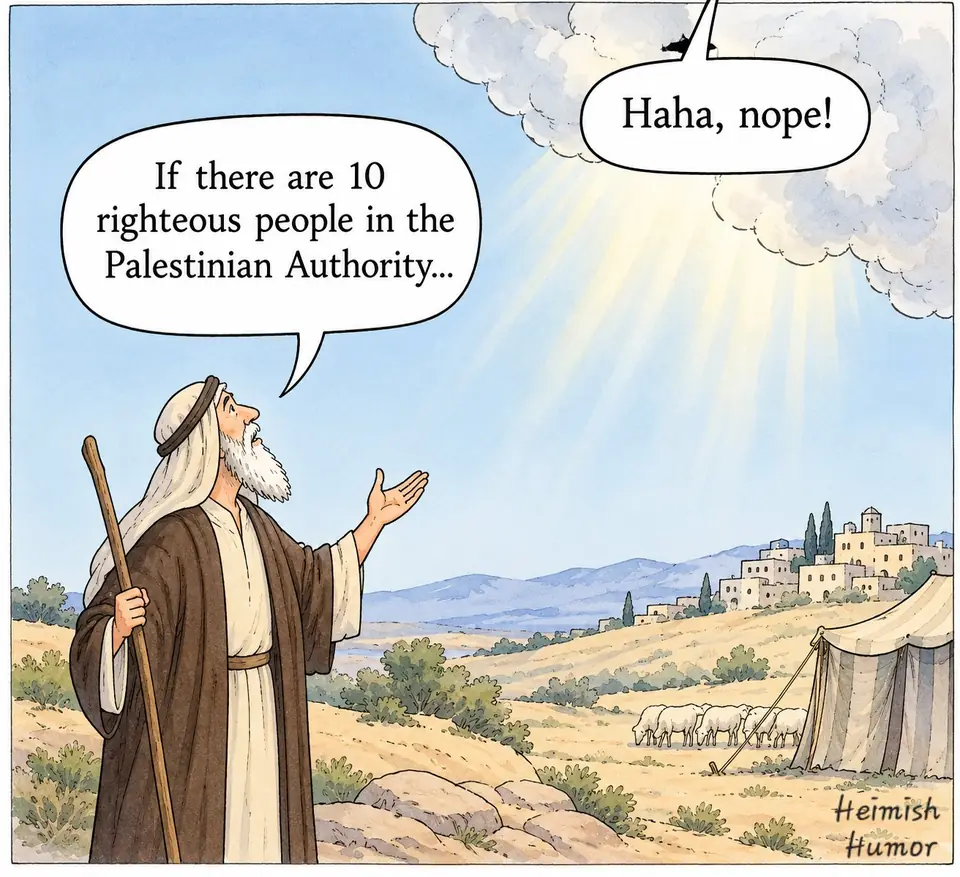
Avraham asks to spare Sedom even for ten tzaddikim (Bereishis 18:32). Heimish Humor imagines the same question today.
G‑d wants us to help Him change His world (57:43; 1:12:44)
In an earlier class on the same dialogue, Rav Dynovisz hears in it G‑d’s own wish: « D.ieu ne veut plus détruire D.ieu veut qu’on l’aide à changer son monde ». And G‑d’s answer to Avraham: « il ne faut pas se décourager de mon monde parce que mon monde est fondamentalement bon et le projet réussira »; « l’histoire ne se fait pas à court terme l’histoire se fait à long terme ».Translation: “G‑d no longer wants to destroy; G‑d wants us to help Him change His world” · “do not lose heart over My world, for My world is fundamentally good and the project will succeed” · “history is not made in the short term; it is made in the long term”
Set no limit between yourself and the good (41:37–58:48)
Why does G‑d send the angels on the third day after the bris (circumcision), at age ninety-nine, in the heat, with no one on the road? Because it was « la première fois qu’Abraham n’a aucune bonne raison de le faire ». « quand il pratique le bien il le pratique sans limite », while « nous conditionnons le bien que nous faisons à nos propres limite ». And when no guest comes: « quand il est pas sollicité il crée la sollicitation chez lui », so « ne pose pas de limite entre toi et le bien ». Even toward Sedom, whose whole ideology punished hospitality, « il ne voit plus ceux qui sont différents de lui il voit des hommes qu’il faut sauver ». The lesson: « ne pose pas de limite dans le bien que tu veux faire et là tu peux espérer voir un jour le bien descendre jusque dans ta semence ».Translation: “the first time Avraham had no good reason to do it” · “when he does good, he does it without limit” · “we make the good we do conditional on our own limits” · “when no one asks, he creates the asking himself” · “set no limit between yourself and the good” · “he no longer sees people who are different from him; he sees people who must be saved” · “set no limit on the good you want to do, and then you may hope to see the good come down one day into your very children”
Sewing heaven and earth back together (10:48–38:24)
After the Akeidah (the binding of Yitzchak), the blessing seems to repeat the first one, with one change: « au début béni en lui à la fin béni en sa semence » (Bereishis 12:3; 22:18). Since Adam’s sin, soul and body, heaven and earth, pull apart; Avraham, who called Hashem koneh shamayim va’aretz, “Owner of heaven and earth” (14:19), began to join them, toward the day when « il n’y a plus de séparation entre l’âme et le corps il n’y a plus de séparation entre le monde spirituel et le monde matériel ». His image: « Abraham ressemble à quelqu’un qui a pris deux morceaux d’un tissu qui avait été déchiré et qui a commencé à le recoudre », until the last stitch, which Mashiach himself will sew.Translation: “at the start, blessed “in you”; at the end, blessed “in your seed”” · “there is no more separation between soul and body, no more separation between the spiritual and the material world” · “Avraham is like someone who took two pieces of a torn cloth and began to sew them back together”
The ego, the idol that never left (13:37–27:13; 06:26–07:08)
The shiur’s second chapter leans on Rav Dynovisz here. In a class on the book of Daniel: « l’idolâtrie c’est quoi mais c’est le culte de la puissance tout simplement »; « l’idolâtrie c’est quoi c’est l’homme qui se prosterne devant sa propre réussite c’est pour ça que l’idolâtrie n’a pas disparu aujourd’hui »; « c’est le culte de l’ego je suis le plus riche je suis le plus puissant je suis le meilleur ». What others call the yetzer hara (the evil inclination), « moi j’appelle ça l’ego l’ego c’est-à-dire le culte de soi ». And in a Shavuos class: « toute définition de ma force en défendent est hors de moi l’éternel s’appelle dans la torah l’idolâtrie », the very “my strength and the might of my hand” of Devarim 8:17.Translation: “what is idol worship? It is simply the cult of power” · “what is idol worship? It is man bowing down before his own success. That is why idol worship has not disappeared today” · “it is the cult of the ego: I am the richest, I am the most powerful, I am the best” · “I call it the ego, that is, the cult of the self” · “any definition of my strength apart from Me, Hashem, is called idol worship in the Torah”
Rav ‘Haïm Dynovisz, “Rav ’Haïm Dynovisz - Chavouot - L’idolâtrie moderne,” YouTube · uploaded May 29, 2022; ~00:07:08 · youtu.be/Ta1qFxlhj24
Anger, the sign of a hidden idol (22:26–25:21; 51:08–51:20)
Why does the Torah tie anger to idol worship? « l’idolâtrie et la colère sont liés »: when I am locked inside a system I have made for myself and reality does not fit it, I either give up or I get angry. « mais si tu te mets en colère c’est la preuve que ce n’est ni la justice ni la paix ni la bonté que tu voulais ». In another class: « il y a pas de colère sans perte tu te mets en colère tu as perdu ». When a great gift is decreed for someone but an accusation stands against him, Hashem sends him something that could make him angry: « si il surmonte la colère il mérite ce qu’on veut lui donner si il sombre dans la colère il perd tout ». Compare the Tanya: had he believed it was from Hashem, “he would not become angry at all” (Iggeres HaKodesh 25).Translation: “idol worship and anger are linked” · “but if you get angry, it proves that it was not justice, peace or kindness you wanted” · “there is no anger without loss: you got angry, you lost” · “if he overcomes the anger he merits what we want to give him; if he sinks into anger he loses everything”
Rav ‘Haïm Dynovisz, “Rav ’Haïm Dynovisz - 12 Vayé’hi - La colère empêche le Machia’h de se dévoiler,” YouTube · uploaded Dec 27, 2023; ~00:51:08–00:51:20 · youtu.be/S9dVERCiWVY
Tanya, Iggeres HaKodesh 25 · chabad.org
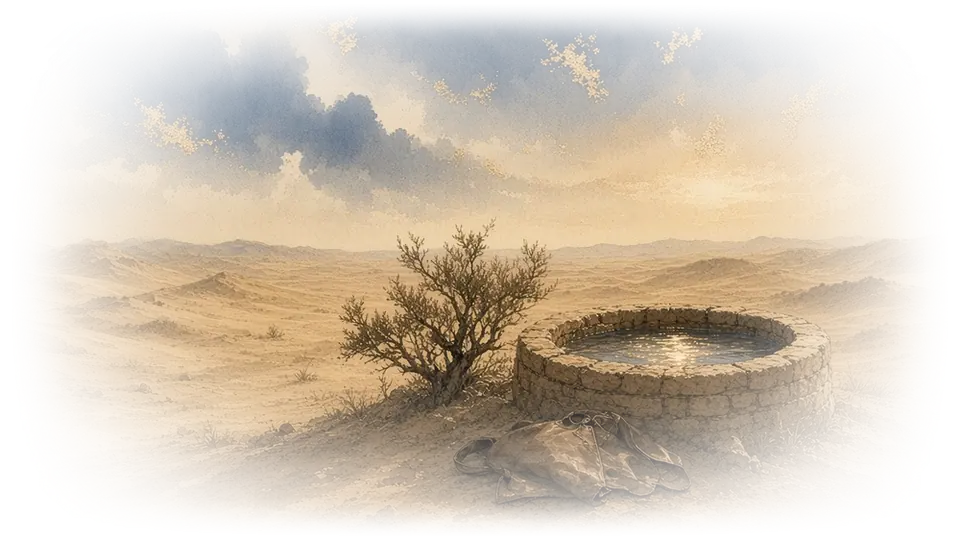
Why nothing was hidden from Avraham (21:30–24:22)
“Shall I conceal from Avraham what I am doing?” (Bereishis 18:17). Nowhere else does G‑d deliberate whether to tell a prophet something. Rabbi YY Jacobson teaches the Chasam Sofer’s answer (in summary): prophecy needs long preparation and inner quiet, and Avraham was always among people, teaching beginners step by step, so by the usual rules his prophecy should have been limited. G‑d says no: “it’s completely wrong to cover anything to hide anything from him… he dedicated his life to be able to spread truth in the world, which is what I want. And it’s for my sake that he hurled his soul in order to change the world.” So “I am going to reveal to him all the secrets that the prophet is capable of receiving and nothing will be concealed from him,” because “the ultimate purpose of creation was not just to be a prophet… G‑d wanted you to change the world. So that’s what he’s doing.” It is the same answer as the Rebbe’s ma’amar on this verse, above: Avraham reached the hidden level through his work below (our link).
Class page · theyeshiva.net/jewish/9476
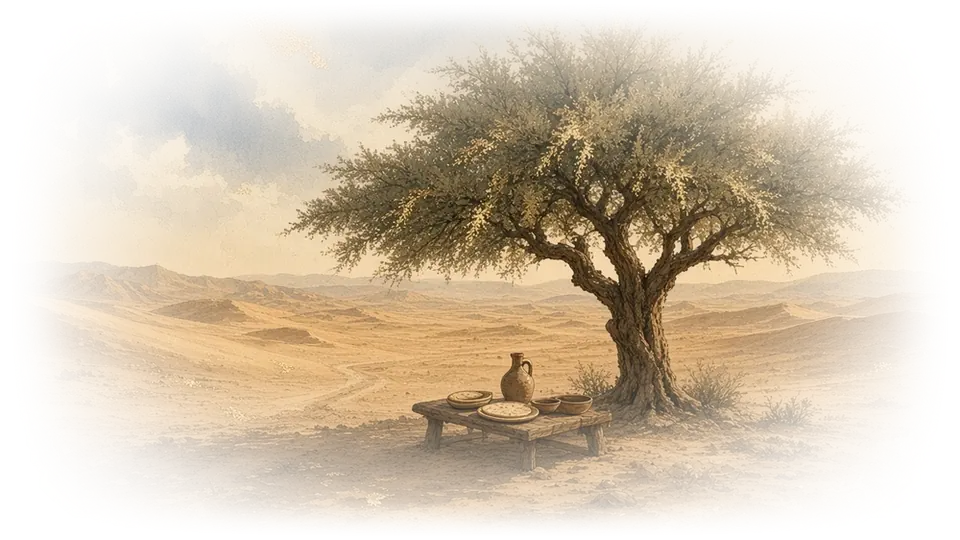
At the Akeidah, the cause itself was going to die (12:52–21:32)
Self-preservation covers not only the body but also one’s ideals. At Ur Kasdim Avraham risked his life; at the Akeidah he gave up his cause: “Here his son represented everything he stood for”; “if no one is going to continue to teach the world about G‑d then all of avraham’s efforts would be reduced to nothing.” At Ur Kasdim an onlooker could call it devotion to a project, “because here the cause itself is going to die.” Ever since, ordinary Jews have given their lives for a mitzvah, because “he opened up that gate of possibility now after he opened the gate others can follow more easily”: “avraham was the father of all selflessness that followed in the course of history.” Rabbi Friedman sends viewers to the Rebbe’s talks; see the Rebbe’s Likkutei Sichos vol. 20, above.
A smile for the table
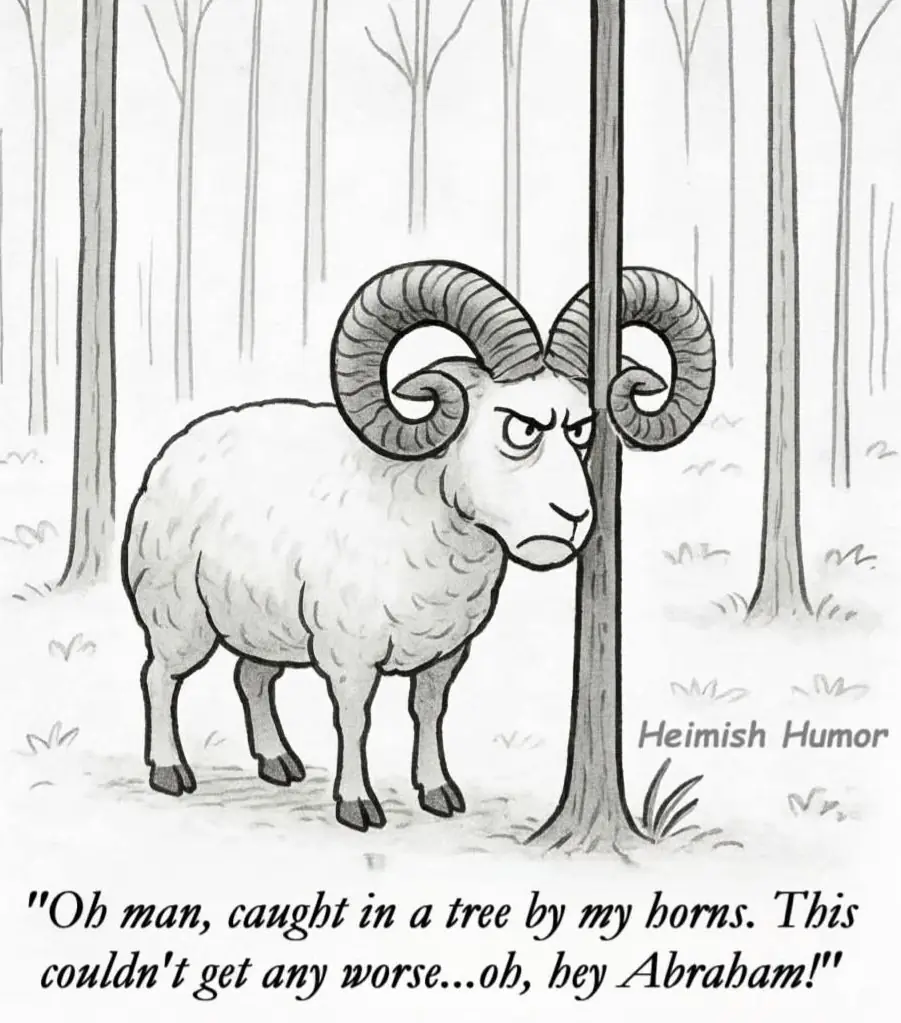
“Avraham lifted his eyes and saw, behold, a ram caught in the thicket by its horns” (Bereishis 22:13).
Don’t be a good father, just be a father (0:00–0:32)
“This father said to me, it was brilliant. He said, ’I’m so busy taking care of my kids, I have no time for my kids.’ … Stop taking care of your kids and just be a father. Don’t be a good father, because then it’s all about you. Just be a father. You’re capable of producing a lot of good stuff, well go ahead. Don’t become it, do it. And then there’s no conflict. You don’t sacrifice anything in G‑d’s world.” Avraham, “father of a multitude of nations” (Bereishis 17:5), ran to his guests without making his kindness about himself (our link).
What marriage demands: humility (0:00–0:24)
“A marriage demands from a person a lot of humility, in the sense that I’m not good by myself. With you, I’m good. Without you, I’m not. … I don’t have to be right, it doesn’t have to go my way. That’s humility. It’s also sanity. If it has to go my way, I’m a narcissist and I’ll never be happy. Marriage demands a certain degree of giving, of generosity that comes from humility.” In this parshah the giver of all givers says, “I am but dust and ashes” (Bereishis 18:27): generosity that comes from humility (our link).
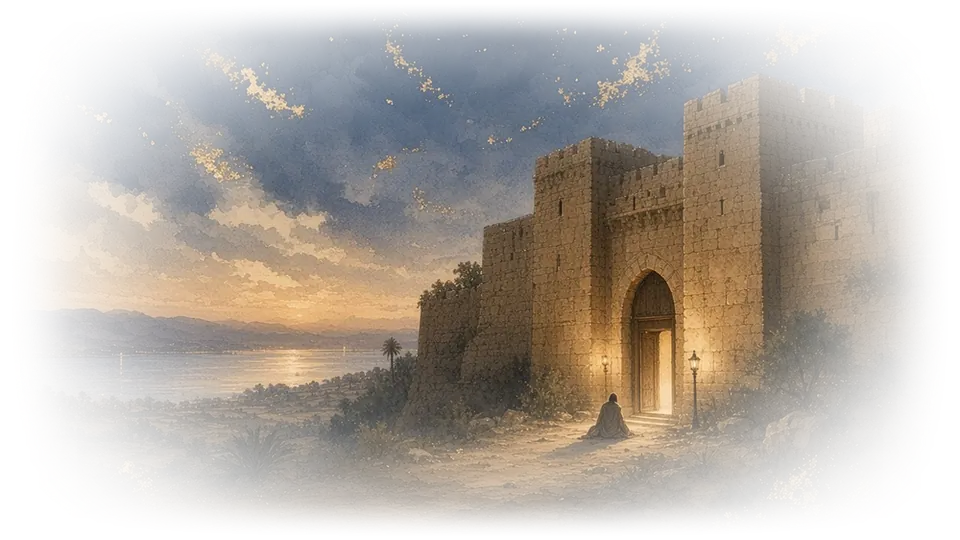
The visit that heals (08:46; 36:49–55:16)
Rabbi Wolf’s class walks step by step through the questions of the Rebbe’s 5750 sichah above (the match is ours; he does not name it). Bikur cholim, visiting the sick, is real medicine: “when you’re visiting the sick you’re actually helping out in their healing.” Avraham’s sickness was the lovesickness of choleh = 49: with the bris he reached the 49th gate, and “he’s now being teased by the 50th level”; “had G‑d not had mercy on him he could have died from an illness.” Then “in that visitation Hashem actually illuminates [Avraham Avinu’s] soul with the 50th level and that’s the healing.”
Avraham’s private Matan Torah (1:00:11–1:04:24)
We count forty-nine days to Shavuos, and the fiftieth “we can’t count that level”: it is given. The bris, the one mitzvah Avraham did because he was commanded, was his private Matan Torah (giving of the Torah). And eilav, “to him”: unlike prophets who fainted, Avraham “was able to absorb this revelation and take it into every fiber of his being.”
Bring it down into daily life (1:10:17; 1:17:00)
The lesson of Vayeira is a “yearning and unquenchable thirst and a longing for absolute truth.” But “the ultimate of the Jew is not transcendental yearning and connection up there… the beauty of the Jew is that we can channel all that down into daily normal living,” the road that leads on to Chayei Sarah.

Avraham, Avraham: the two “I”s (Bereishis 22:11)
“Both the animal soul and the Divine soul of man possess an ego and superego, both referred to as I. The difference is that the animal soul’s ego and superego are both egocentric, while the Divine soul’s ego and superego are not egocentric at all. In Hebrew, the ego’s I and the superego’s I have two distinct names: ani and anochi, respectively.” At the Akeidah the angel calls “Avraham, Avraham,” twice: once to his Divine ani and once to his Divine anochi. “Abraham-ani, Abraham-anochi = 638 = Abraham-Yitzchak-Yaacov, all three patriarchs within Abraham (you and he within I)!” (Check: אברהם 248 + אני 61 + אברהם 248 + אנכי 81 = 638 = אברהם 248 + יצחק 208 + יעקב 182.)
He, You, I: Torah, prayer, kindness
“When we learn Torah, we relate to G‑d, the Giver of the Torah, as He, in the third person… When we pray to G‑d, we relate to Him as You, in the second person… When we devote ourselves to acts of lovingkindness, we emulate G‑d Himself, to the extent that His I enters and merges with our I - I am working as an agent of G‑d… I is the pronoun of Abraham, the first father, the pillar of lovingkindness.” These are the three pillars the world stands on, Torah, avodah (prayer) and gemilus chassadim (kindness) (Avos 1:2).
A tzaddik holds all four sides
“A true tzaddik does not need to erase one side in order to reveal the other. He can hold opposites together because he is connected to a point higher than both.” “In Hebrew, the word for side is Tzad”; it is “the beginning, the two essential letters of the word Tzaddik,” and the initials of the four directions, צפון, דרום, ים, קדם, spell צדיק. So the tzaddik is “the living paradox that unites all sides of reality, all sides of humanity.” Avraham, all chesed, also held the gevurah (strength, restraint) of the Akeidah (our link).
Avraham spells “come quickly”
Avraham sat in the heat with no travelers on the road, “but Abraham does not despair”: “Three angels come to Abraham, three new angels who were created just then with the power of Abraham’s desire to fulfill the mitzvah of hosting guests.” Then he ran and hurried: “If we rearrange the letters in the name Abraham, אברהם, we receive בא מהר, which means, ’come quickly’.” With zrizim makdimim lemitzvos (the eager hurry to do mitzvos): “Those who act with alacrity propel the arrival of the Redeemer forward and say to him, בא מהר, ’Come quickly!’” Rav Dynovisz says the same of the guests, above: when no one asked, Avraham created the asking.
The eishel: “ask”
The Rebbe’s eishel, above, is unlimited giving; Rav Ginsburgh’s is unlimited asking. Eishel (אשל) shares its letters with she’al (שאל), “ask.” “When Abraham planted the eshel, he was planting that innermost feeling that we can ask anything of G‑d, and there is nothing that can stop Him from fulfilling our request. When guests would finish their feast at Abraham’s eshel (inn), he would ask them to thank G‑d for the food that they had eaten.” That is the order of prayer itself: praise, request, thanks (Berachos 34a).

Where your eyes are, there you are (0:03–2:06)
“Where the eyes of the person are, that’s where the person is”: “a person can be in the study hall but is on the street, because his eyes are on the street. And a person can be on the street and he is in the study hall, because he only thinks about Hashem.” So David HaMelech says, “Va’ani tamid imach,” “I am always with You” (Tehillim 73:23). And on blessings: “his friend who is not happy with his share loses his share. Who takes it? The one who has a good eye.” “Be truly happy for others, and honor everyone.” The Mishnah calls this the mark of Avraham’s students, a good eye (Avos 5:19), and in this parshah Avraham runs to strangers and pleads even for Sedom (our link).
Don’t be stingy, especially with words
Rabbi Shalom Arush teaches: “being stingy is being the opposite of Hashem,” because “Hashem is all giving and someone who is stingy only takes.” “We are told to emulate Hashem - so don’t be stingy! If this is true of money - then all the more so is it true of WORDS.” So “Encourage your spouse, your kids, and your friends,” and “Make sure you are heaping on many times the positivity than the criticism!”. In Vayeira, G‑d Himself visits Avraham after his bris, and the Gemara learns: “G‑d visits the sick, as it is written, ’G‑d appeared to him in the plains of Mamre’; so should you too visit the sick” (Sotah 14a).
Sotah 14a, Parshah In Depth, Chabad.org · chabad.org
A smile for the table
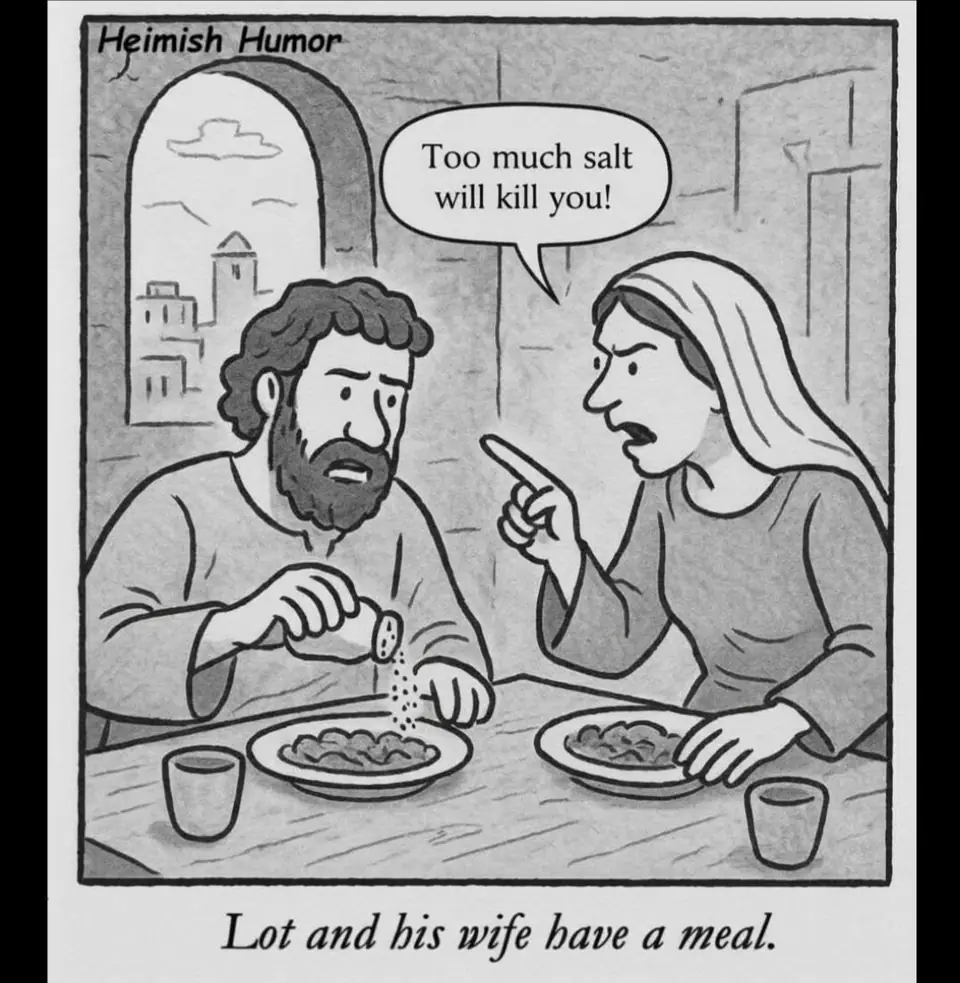
Stinginess in Sedom went all the way down to the salt. Rashi on 19:26: “She sinned with salt, and she was punished with salt. He said to her, ’Give a little salt to these guests.’ She replied, ’Also this evil custom you wish to introduce into this place?’”
AI and the soul
Rav Ginsburgh on the week’s technology headlines: “Every previous technological revolution changed the objects around us. AI is different. It attempts to make an object into a subject. But the ability to truly relate to another person and to G‑d, remains unique to the human soul.” The shiur’s fourth chapter builds on his video answer: G‑d “breathed into his nostrils the soul of life” (Bereishis 2:7), and Onkelos calls it ruach memalela, “a speaking spirit.”
Stabbed on 47th Street, back the next day
On Wednesday evening, October 21, a young rabbi named Yosef, 26, of Crown Heights, was stabbed in the lower back, apparently with a large syringe, on West 47th Street in Manhattan, the blocks where he helps Jews put on tefillin. He was treated at Bellevue, and by Thursday he was back on the same blocks. On Motzaei Shabbos, Shomrim announced that a suspect was in custody. His words: “I keep thinking about my grandparents. They survived the Holocaust, experienced the worst of hatred, and still went on to build a proud Jewish family. … Their answer to hatred was more Jewish life. Mine will be too. We’ll never back down. We’ll just keep spreading more light.” The Rebbe wrote in 5713 (1952): “it is not enough to serve Hashem today as one did yesterday… Therefore it is necessary to add more light every day.” And in the Rebbe’s words above, “it is like Avraham is leading him to the Akeidah.”
COLlive (arrest) · Oct 24, 2026
The Rebbe, Igros Kodesh vol. 7, #2057, 23 Kislev 5713 (Torah Recordings translation) · torahrecordings.com
Two thousand guests, hundreds of open homes
Last weekend “nearly 2,000 participants” from 160 universities in six countries came to Crown Heights for Chabad on Campus’s Pegisha Shabbaton, and “participants were welcomed into the homes of hundreds of Crown Heights families for Friday night dinner.” That is Avraham’s tent, open on all four sides (Avos deRabbi Nosson 7). The Rambam: “This is the statute which Avraham instituted and the path of kindness which he practiced: to give food and drink to wayfarers and to accompany them. [Indeed,] affording hospitality to guests surpasses receiving G‑d’s Presence” (Hilchos Eivel 14:2). The Rebbe adds that Avraham “empowered every one of us to show hospitality in a manner which surpasses receiving the Divine Presence.”
The Rebbe, “Avraham’s Heritage of Kindness” (Sichos Erev Rosh HaShanah 5723), Chabad.org · chabad.org
A smile for the table
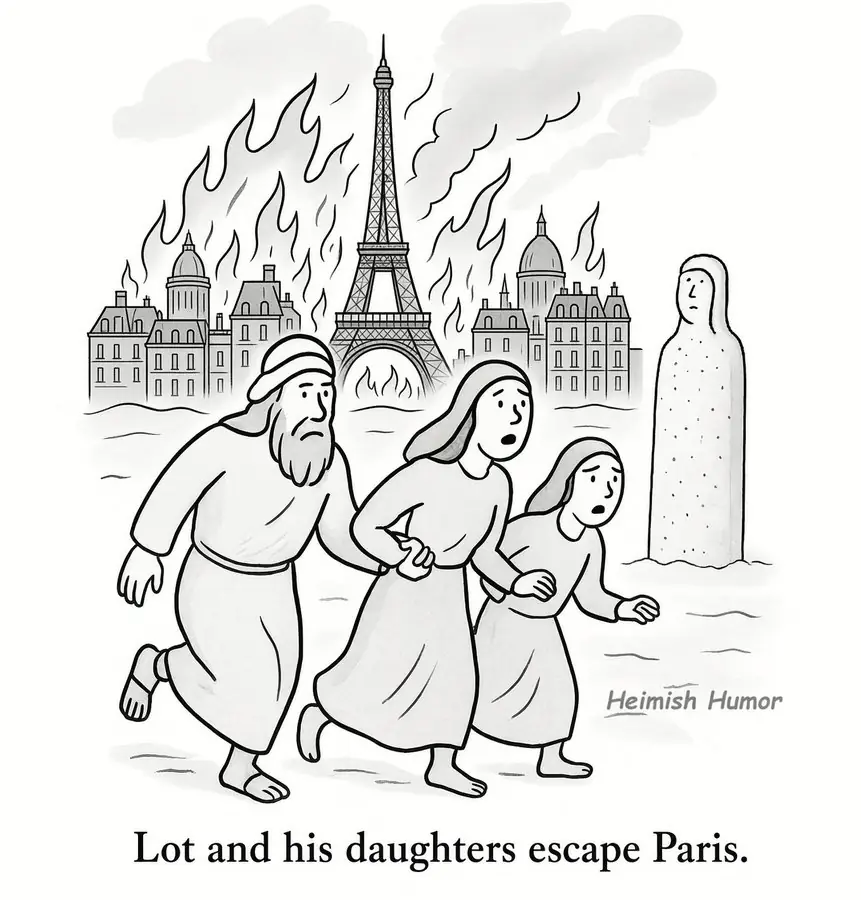
A bit of dark humor about where Jews feel safe today.

From Sedom to Mashiach
After Sedom is destroyed, Lot and his two daughters, the only survivors of their family, hide in a cave in the mountains. The daughters believe the whole world has been destroyed, as in the Mabul (the Flood), and that they are the last people left (Bereishis Rabbah 51:8). Their mother is gone, and so is any hope of a husband. The older daughter says, “Our father is old, and there is no man in the world to marry us in the usual manner” (Bereishis 19:31). Two nights in a row they give Lot wine, and each daughter conceives a child from him. The older names her son Moav, “from father,” and the younger names hers Ben-Ami, “son of my kindred,” the ancestors of Moav and Ammon (Bereishis 19:37–38).
Who is to blame? Most of our Sages judge the daughters favorably and fault Lot. The Midrash reads “the isolated one seeks lust” (Mishlei 18:1) as being about Lot (Bereishis Rabbah 51:9). He had chosen Sedom in the first place, and even after he understood what had happened the first night, he drank again the second (Bereishis Rabbah 51:9; Midrash Tanchuma, Vayeira 12). The Gemara applies a verse to them: the daughters, who meant it for a mitzvah, “the righteous will walk in them,” and Lot, “the transgressors will stumble in them” (Horayos 10b, on Hoshea 14:10). Avraham moved away right afterward, Rashi explains, to keep his distance from Lot’s disgrace (Rashi, Bereishis 20:1).
Why the daughters are honored. They believed they had to keep the human race going. That is why the Torah’s ban on marrying Moabites and Ammonites (Devarim 23:4) applies only to the men and not the women, in honor of the mothers’ intentions (Pesikta Rabbati 42). The older daughter acted first, so her line joined the Jewish people four generations earlier (Bava Kamma 38b).
The light hidden in the darkness. From Moav came Rus (Ruth), great-grandmother of King David. From Ammon came Naamah, wife of King Shlomo and mother of Rechavam, from whom Mashiach descends (Bereishis Rabbah 51:8). The Midrash says the wine in the cave appeared by a miracle, a taste of Mashiach’s time (Bereishis Rabbah 51:8). On the verse “I have found David My servant” (Tehillim 89:21), it asks, “Where did He find him? In Sedom!” (Bereishis Rabbah 41:4).
Why would the greatest soul come through such a low place? Rabbi Meir of Premishlan gave a parable: a merchant smuggling precious goods past customs covers them in dirt, so no one suspects their value. In the same way, Hashem sent the souls of David and Mashiach down through unions that look unworthy, so the forces of evil would not try to stop them (cf. Siftei Kohen, Bereishis 38:1). The Tzemach Tzedek, the third Lubavitcher Rebbe, explains that David’s kingship comes from a source so lofty that it could only be drawn out from the deepest low (Derech Mitzvosecha, p. 58).
A story. In 1921, in Luban, a Torah scholar became fatally ill with a strange swelling of the tongue. He told his rav, Rav Moshe Feinstein, that the week before he had preached harshly against Lot’s daughters. Two very old women had appeared to him in a dream, introduced themselves as Lot’s daughters, and told him he was being punished through his tongue. They had believed they were the last people alive. They had made the story public on purpose, through their sons’ names, so that no later generation could ever claim a child was born without a father and build a false messiah on it. For that, they said, they merited that the true Mashiach would come from them. He finished telling the dream and passed away (Igros Moshe, vol. 8, introduction).
The boy who wept to see G‑d, and his soldiers
This Shabbos is 20 Cheshvan, the birthday of the Rebbe Rashab (Rabbi Sholom DovBer, the fifth Lubavitcher Rebbe, born 5621/1860). At four or five “he came to his grandfather, the Tzemach Tzedek, on Shabbos Parshas Vayeira and began to cry. ’Why did G‑d reveal Himself to Avraham, but does not reveal Himself to us?’” The answer: “When a Jew who is a tzaddik decides at the age of ninety-nine that he must circumcise himself, he is worthy of having G‑d reveal Himself to him.” That boy founded Yeshivas Tomchei Temimim (5657/1897): “The Rebbe Rashab explained that the objective of the House of David is to bring Moshiach… Temimim are the “soldiers” whose task is to battle for the revelation of Moshiach… (Nowadays, of course, everyone is encouraged to also help.)” And the tears point to the Geulah itself: “the essence of the Era of the Redemption will be the direct revelation of G‑d; ’Your Master will conceal Himself no longer, and your eyes will perceive your Master.’ As we stand on the threshold of this era, the inner thirst can be felt more powerfully.” In 5750 the Rebbe said the shout of “Ad massai” (“Until when?”) “reflects the great yearning for G‑dliness which will be satisfied by the revelations of the Messianic era. May it be now, immediately.”
“Rabbi Sholom DovBer Schneersohn,” Chabad.org · chabad.org
The Rebbe, “Seeing Truth,” In the Garden of the Torah, Vayeira, Chabad.org · chabad.org
The Rebbe, Shabbos Parshas Vayeira 5750, Chabad.org · chabad.org
Building blocks of the Geulah (09:47–23:40)
Rabbi Simon Jacobson on Tanya chapter 37: the goal, from the Rambam, is that “The business of the world will be nothing but to know G‑d.” It is not handed down from outside: “It is our actions that bring Gilyui Eyn Sof in this world,” and with each mitzvah “you’re revealing a little piece of Mashiach and Geulah.” Every good act since the beginning of time “is revealing it’s a building block of giluy Atzmus. And when those building blocks accumulate, that’s Mashiach and Geulah.” The “values that Avraham Avinu pioneered” have, over time, become part of the standard of our world. So: “We’re not bystanders.”
Torah and commentaries
- Bereishis 1:2–4, “Let there be light,” with Rashi on 1:4 · sefaria.org/Rashi_on_Genesis.1.4.1
- Bereishis 2:7, “He blew into his nostrils the soul of life” · sefaria.org/Genesis.2.7
- Bereishis 14 (Avraham’s war against the four kings), with Ramban on 14:1 · sefaria.org/Ramban_on_Genesis.14.1
- Bereishis 18:1 with Rashi (visiting Avraham on the third day after his bris) · chabad.org/library/bible_cdo/aid/8213/jewish/Chapter-18.htm
- Bereishis 18:2, Rashi (one angel, one mission) · sefaria.org/Rashi_on_Genesis.18.2
- Bereishis 18:27, “I am dust and ashes” · chabad.org/library/bible_cdo/aid/8213/jewish/Chapter-18.htm
- Bereishis 19:16 with Rashi · chabad.org/library/bible_cdo/aid/8214/showrashi/true · sefaria.org/Rashi_on_Genesis.19.16
- Bereishis 19:17, Rashi; 19:22; 19:29
- Bereishis 19:24, “sulfurous fire” on Sedom · sefaria.org/Genesis.19.24
- Bereishis 19:31; 19:37–38
- Bereishis 20 (Sarah in Avimelech’s house); Rashi on 20:1 and 20:16
- Bereishis 21:1 with Rashi; Chizkuni, Kitzur Baal HaTurim, Lekach Tov and Siftei Kohen on 21:1
- Bereishis 21:18–19 (Hagar’s well)
- Bereishis 21:33 with Rashi (the eshel) · sefaria.org/Rashi_on_Genesis.21.33
- Bereishis 22:12 · sefaria.org/Genesis.22.12
- Bereishis 25:9, Rashi · sefaria.org/Rashi_on_Genesis.25.9
- Ramban on Bereishis 26:20 (the three wells and the three Batei Mikdash) · sefaria.org/Ramban_on_Genesis.26.20
- Bereishis 31:42, “the Fear of Yitzchak”
- Ohr HaChaim on Bereishis 12:13
- Ohr HaChaim on Bereishis 19:16 · sefaria.org/Or_HaChaim_on_Genesis.19.16
- Gur Aryeh on Bereishis 19:16 · sefaria.org/Gur_Aryeh_on_Bereishit.19.16
- Tur HaAroch on Bereishis 19:16 · sefaria.org/Tur_HaArokh,_Genesis.19.16
- Chibbah Yeteirah on Bereishis 19:16 · sefaria.org/Chibbah_Yeteirah_on_Torah,_Genesis.19.16.1
- Birkat Asher on Bereishis 19:16 · sefaria.org/Birkat_Asher_on_Torah,_Genesis.19.16
- Malbim on Bereishis 19:15 · sefaria.org/Malbim_on_Genesis.19.15
- Siftei Kohen on Bereishis 38:1 (cf.)
- Bamidbar 5:28
- Devarim 6:4, Rashi · sefaria.org/Rashi_on_Deuteronomy.6.4.1
- Devarim 8:17–18, “my strength and the might of my hand” · chabad.org/library/bible_cdo/aid/9972/jewish/Chapter-8.htm
- Devarim 23:4
- Devarim 30:6 with Ramban · sefaria.org/Ramban_on_Deuteronomy.30.6.1
- Tehillim 73:23; Tehillim 89:21
- Mishlei 18:1; Hoshea 14:10
- Yechezkel 38–39 (Gog uMagog); Yechezkel 38:22 · sefaria.org/Ezekiel.38.22
- Siddur, end of the Amidah: “may my soul be as dust to all”
Talmud and Midrash
- Nedarim 32a · sefaria.org/Nedarim.32a.18
- Shabbos 105b · sefaria.org/Shabbat.105b.8
- Shabbos 118a (three Shabbos meals) · sefaria.org/Shabbat.118a.7
- Chagigah 12a · sefaria.org/Chagigah.12a.9-11
- Taanis 21a · sefaria.org/Taanit.21a.11
- Pesachim 50a · sefaria.org/Pesachim.50a.16-19
- Pesachim 88a (mountain, field, house) · sefaria.org/Pesachim.88a.4
- Sukkah 52a · sefaria.org/Sukkah.52a.4
- Eruvin 22a · sefaria.org/Eruvin.22a.5
- Berachos 31b
- Sotah 10a–b (on Bereishis 21:33) · sefaria.org/Sotah.10a.21-10b.1
- Sotah 14a · Chabad.org, Parshah In Depth: chabad.org/parshah/in-depth/plainBody.aspx?AID=2620&rewrite=0
- Sotah 17a
- Bava Kamma 38b; Bava Kamma 92a
- Bava Basra 16b · sefaria.org/Bava_Batra.16b.15
- Horayos 10b
- Tosafos, Bava Metzia 86b · sefaria.org/Tosafot_on_Bava_Metzia.86b.20.1
- Bereishis Rabbah 41:4; 51:8; 51:9
- Bereishis Rabbah 42:4 · sefaria.org/Bereshit_Rabbah.42.4
- Bereishis Rabbah 50:2 · sefaria.org/Bereshit_Rabbah.50.2
- Bereishis Rabbah 53:6
- Koheles Rabbah 7:16 · sefaria.org/Kohelet_Rabbah.7.16.1
- Midrash Tehillim 118:12 (Gog uMagog three times) · sefaria.org/Midrash_Tehillim.118.12
- Yalkut Shimoni, Yeshayahu 499 · sefaria.org/Yalkut_Shimoni_on_Nach.499.1
- Midrash Tanchuma, Vayeira 12
- Pesikta Rabbati 42
- Zohar I 119b · sefaria.org/Zohar,_Vayera.33.490 · tr. Moshe Miller, “Fire and Water,” Chabad.org: chabad.org/kabbalah/article_cdo/aid/568667/jewish/Fire-and-Water.htm
Rambam and later authorities
- Rambam, Mishneh Torah, Hilchos Avodas Kochavim 1:3 (tr. E. Touger) · chabad.org/library/article_cdo/aid/912359/jewish/Avodah-Zarah-vChukkot-HaGoyim-Chapter-1.htm
- Rambam, Mishneh Torah, Hilchos De’os 2:3 · sefaria.org/Mishneh_Torah,_Human_Dispositions.2.3
- Rambam, Mishneh Torah, Hilchos Melachim 12:1 · sefaria.org/Mishneh_Torah,_Kings_and_Wars.12.1
- Rambam, Mishneh Torah, Hilchos Melachim 12:2 (tr. as quoted in Mendel Dubov, “Gog and Magog,” Chabad.org) · sefaria.org/Mishneh_Torah,_Kings_and_Wars.12.2 · chabad.org/library/article_cdo/aid/4511335/jewish/Gog-and-Magog.htm
- Rav Moshe Feinstein, Igros Moshe, vol. 8, introduction
Chassidus and the Rebbe
- Tanya, ch. 2 · chabad.org/library/tanya/tanya_cdo/aid/7881/jewish/Chapter-2.htm
- Tanya, Iggeres HaKodesh 2 · sefaria.org/Tanya,_Part_IV;_Iggeret_HaKodesh.2.4
- Tanya, Iggeres HaKodesh 11 · chabad.org/library/tanya/tanya_cdo/aid/1029301/jewish/Epistle-11.htm
- Tanya, Iggeres HaKodesh 13 · sefaria.org/Tanya,_Part_IV;_Iggeret_HaKodesh.13.6
- Tanya, Iggeres HaKodesh 25 · chabad.org/library/tanya/tanya_cdo/aid/7970/jewish/Epistle-25.htm
- The Rebbe, Likkutei Sichos vol. 19, Re’eh 1 (Sichos in English, tr. Touger/Wineberg) · chabad.org/therebbe/article_cdo/aid/6382182/jewish/Reeh-Enabling-G-ds-Hidden-Kindness-to-Be-Revealed.htm
- The Rebbe, Likkutei Sichos vol. 25, Vayeira 2
- The Rebbe, Kuntres Shabbos Matos-Masei 5722 (Sefer HaMaamarim Meluket IV, p. 333ff; tr. Eli Touger) · chabad.org/therebbe/article_cdo/aid/145252/jewish/Part-I.htm
- “I Will Show You Wonders, 5751 (1991),” public statements of the Rebbe, Sichos in English, Chabad.org · chabad.org/therebbe/article_cdo/aid/2487492/jewish/I-Will-Show-You-Wonders-5751-1991.htm
- The Tzemach Tzedek, Derech Mitzvosecha, p. 58
- Rabbi Meir of Premishlan, the parable of the merchant and the customs house (as told in Mendel Braun’s article, below)
Teachers and online sources
- Rav Haim Dynovisz, “Le combat entre l’ego et la vérité” (cours sur le livre de Daniel), YouTube, ~14:32 and ~15:11 · youtube.com/watch?v=QRSWdjbhCBY&t=872
- Rav Haim Dynovisz, “12 Haftara Vayé’hi - La colère fait exploser l’âme,” YouTube (Archives 260), ~22:26 · youtube.com/watch?v=6N5kCEvl3VM&t=1165
- Rabbi YY Jacobson, “Addiction Is Not the Problem; It’s the Solution” (Essay, Ki Sisa), theyeshiva.net · theyeshiva.net/jewish/item/925/essay-ki-sisa-addiction-is-not-the-problem-its-the-solution
- Rabbi Manis Friedman, “Don’t Take Yourself So Seriously: Humility and Anger,” Chabad.org · chabad.org/library/article_cdo/aid/398911/jewish/Dont-Take-Yourself-So-Seriously.htm
- Rabbi Manis Friedman, “Don’t try to be a good father,” video on X · x.com/ManisFriedman/status/2115170576717197703
- Rabbi Manis Friedman, “What does marriage demand from a person?,” video on X · x.com/ManisFriedman/status/2114753858320683302
- Rav Yitzchak Ginsburgh, “Man created from dust,” video on X, Oct 28, 2026 · x.com/RabbiGinsburgh/status/2115512924848476357
- Rav Yitzchak Ginsburgh, on artificial intelligence and the human soul, video on X, Oct 27, 2026 · x.com/RabbiGinsburgh/status/2115150033486254309
- Rav Yitzchak Ginsburgh, “Let there be light,” post on X, Oct 27, 2026 · x.com/RabbiGinsburgh/status/2115080130888344038
- Rabbi Shalom Arush, “The Secret to Receiving Blessings,” video on X (Breslev English) · x.com/ShalomArushEN/status/2114469433561534524
- Rabbi Shalom Arush, “Don’t be stingy,” video on X (Breslev English), Oct 28, 2026 · x.com/ShalomArushEN/status/2115585442443911596
- Rabbi Eliezer Shemtov, on Hagar’s well, Chabad.org · chabad.org/7558015
- Mendel Braun, “The Untold Story of Lot and His Daughters,” Chabad.org · chabad.org/7558016
Also cited in this sheet
- The Rebbe, Sefer HaMa’amarim 5737, ma’amar “Hamechaseh Ani MeiAvraham,” Shabbos Parshas Vayeira, 20 Marcheshvan 5737, in The Teachings of The Rebbe 5737 vol. 1, tr. A. & Y. Markel (Neirot Foundation, 2026) · Discourse 8, pp. 188, 193, 197–198 (the book’s heading misprints the parshah as “Va’era”) · neirot.com
- The Rebbe, Shabbos Parshas Vayeira, 20th Day of MarCheshvan 5750, Sichos in English, Chabad.org · chabad.org
- The Rebbe, “Vayeira: A Heritage of Generosity,” Likkutei Sichos vol. 3, p. 769ff, Chabad.org · §9 · chabad.org
- The Rebbe, “What Makes a Jewish Martyr Unique,” Likkutei Sichos vol. 20, p. 73ff, Chabad.org · §§6, 8 · chabad.org
- Rav ‘Haïm Dynovisz, “04 Vayéra - Avraham, le Premier et le Seul… Modèle d´un vrai révolutionnaire,” YouTube · uploaded Nov 6, 2025; ~00:28:40–00:33:02; 00:51:19 · youtu.be/JQHr8UTPNek
- Heimish Humor (cartoon) · Bereishis 18:32
- Rav ‘Haïm Dynovisz, “04 Vayéra - Ce que le vrai judaïsme apporte,” YouTube · uploaded Oct 30, 2023; ~00:57:43; 01:12:44 · youtu.be/tyTYm1oDzU0
- Rav ‘Haïm Dynovisz, “Être ce que l’on pense,” YouTube · uploaded Oct 31, 2023; ~00:41:37–00:52:44; 00:58:48 · youtu.be/F-ZYnamgf80
- Rav ‘Haïm Dynovisz, “Rav ’Haïm Dynovisz - Chavouot - L’idolâtrie moderne,” YouTube · uploaded May 29, 2022; ~00:07:08 · youtu.be/Ta1qFxlhj24
- Rav ‘Haïm Dynovisz, “Rav ’Haïm Dynovisz - 12 Vayé’hi - La colère empêche le Machia’h de se dévoiler,” YouTube · uploaded Dec 27, 2023; ~00:51:08–00:51:20 · youtu.be/S9dVERCiWVY
- The Chasam Sofer, as taught by Rabbi YY Jacobson, “Is It Possible that Your Soul Signed Off on Everything that Goes Down in Your Life?”, TheYeshiva.net · YouTube; ~00:21:30–00:24:22 · youtu.be/ODzkPEZck0I
- Class page · theyeshiva.net/jewish/9476
- Rabbi Manis Friedman, “The Binding of Isaac & TRUE Sacrifice,” YouTube · Nov 11, 2022; ~00:12:52–00:21:32 (captions) · youtu.be/LINb3_tK_us
- Rabbi Reuven Wolf, “Vayeira – A Healing Touch,” YouTube · Oct 23, 2018; ~00:08:46; 00:36:49–00:55:16 (captions) · youtu.be/baSYpARWVzA
- Rav Yitzchak Ginsburgh, X · Oct 26, 2026 · x.com/RabbiGinsburgh/status/2114744264467120468
- Rav Yitzchak Ginsburgh, X · Oct 26, 2026 · x.com/RabbiGinsburgh/status/2114784109889261683
- Rav Yitzchak Ginsburgh, X · Oct 25, 2026; video ~00:00–01:01 · x.com/RabbiGinsburgh/status/2114409872921932233
- Rav Yitzchak Ginsburgh, “Vayeirah: New Creation,” Gal Einai · Nov 8, 2022 · inner.org
- Rav Yitzchak Ginsburgh, “Abraham’s Eshel: Asking Questions About G‑d,” Gal Einai (Ma’ayan Ganim) · Nov 14, 2019 · inner.org
- Rashi, Bereishis 19:26 (Bereishis Rabbah 50:4), Chabad.org · chabad.org
- Tzali Reicher, “A Day After Midtown Stabbing, Young Rabbi Is Back in Diamond District,” Chabad.org · Oct 22, 2026 · chabad.org
- COLlive (arrest) · Oct 24, 2026
- The Rebbe, Igros Kodesh vol. 7, #2057, 23 Kislev 5713 (Torah Recordings translation) · torahrecordings.com
- “Made for This: Nearly 2,000 Participants Fill Crown Heights for Pegisha,” CrownHeights.info · Oct 28, 2026 · crownheights.info
- The Rebbe, “Avraham’s Heritage of Kindness” (Sichos Erev Rosh HaShanah 5723), Chabad.org · chabad.org
- Hayom Yom, 9 Cheshvan, Chabad.org · chabad.org
- “Rabbi Sholom DovBer Schneersohn,” Chabad.org · chabad.org
- The Rebbe, “Seeing Truth,” In the Garden of the Torah, Vayeira, Chabad.org · chabad.org
- Rabbi Simon Jacobson, “What Is the Age of Moshiach and How Does it Arrive,” MyLife: Chassidus Applied, YouTube · Oct 25, 2026; ~00:09:47–00:18:16 (captions) · youtu.be/jgPHQrn525k
|
|
|